
Hybrid GC-FO Solver
This example demonstrates the adaptive hybrid solver that dynamically switches between full orbit (FO) and guiding center (GC) tracing based on the local adiabaticity parameter ε = ρ_L / R_c.
We use a magnetic bottle field where the adiabaticity varies spatially: near the midplane ε is large (non-adiabatic → FO), and near the mirror points ε is small (adiabatic → GC).
using TestParticle, OrdinaryDiffEq, StaticArrays
import TestParticle as TP
using LinearAlgebra, Random, Printf, Markdown
using Chairmarks, Statistics
using CairoMakie
Magnetic Bottle Configuration
The magnetic field satisfies ∇·B = 0:
A larger α produces stronger curvature at the midplane, which raises the adiabaticity parameter ε there.
const B0 = 1.0e-4   # [T]
const α = 1.0e-2    # [m⁻²]

function bottle_B(x, t)
    Bz = B0 * (1 + α * x[3]^2)
    Bx = -B0 * α * x[1] * x[3]
    By = -B0 * α * x[2] * x[3]
    return SA[Bx, By, Bz]
end

B_field = TP.Field(bottle_B)
E_field = TP.Field((x, t) -> SA[0.0, 0.0, 0.0])

m = TP.mᵢ
q = TP.qᵢ
q2m = q / m;
Step 1: Full Orbit Reference Trace
First we trace the proton using the standard ODE solver to confirm it is trapped and bounces inside the magnetic bottle.
The proton is initialized at the midplane
x0 = SA[0.0, 0.0, 0.0]
v_perp = 5.0e4  # [m/s]
v_par = 1.0e5   # [m/s]
v0 = SA[v_perp, 0.0, v_par]
u0 = vcat(x0, v0)

Ω = abs(q2m) * B0
T_gyro = 2π / Ω

# Trace long enough to see several bounces
tspan = (0.0, 30 * T_gyro)

param_fo = prepare(E_field, B_field; species = Proton)
prob_fo = ODEProblem(trace, u0, tspan, param_fo)
sol_fo = solve(prob_fo, Vern6())

# Verify trapping: z should oscillate, not diverge
z_fo = [u[3] for u in sol_fo.u]
@assert maximum(abs, z_fo) < 1.0e4 "Particle escaped the bottle!"
Step 2: Guiding Center Reference Trace
For comparison, we also trace with the guiding center equations. Note that trace_gc! traces the guiding-center position
bottle_B_static(x) = bottle_B(x, 0.0)
bottle_E_static(x) = SA[0.0, 0.0, 0.0]

stateinit_gc, param_gc = TP.prepare_gc(
    u0, bottle_E_static, bottle_B_static; species = Proton
)
prob_gc = ODEProblem(trace_gc!, stateinit_gc, tspan, param_gc)
sol_gc = solve(prob_gc, Vern6());
Step 3: Hybrid Solver
The adaptive hybrid solver switches between FO and GC based on the adiabaticity parameter and a threshold.
# The classical adiabaticity criterion: ε = ρ_L / R_c < 0.1
threshold = 0.1

p = (q2m, m, E_field, B_field, ZeroField())

alg = AdaptiveHybrid(;
    threshold,
    dtmax = T_gyro,
    dtmin = 1.0e-4 * T_gyro,
    maxiters = 500_000,
    check_interval = 10,
)

# Set verbose = true to see the dynamic switching
prob_hybrid = TraceHybridProblem(u0, tspan, p)
sol = solve(prob_hybrid, alg; verbose = false, seed = 1234).u[1];
Step 4: Compute Adiabaticity
The adiabaticity parameter ε = ρ_L / R_c measures how well the guiding center approximation holds. When ε < threshold, GC is valid; when ε ≥ threshold, we need full orbit tracing.
ε_fo = get_adiabaticity(sol_fo)
ε_gc = get_adiabaticity(sol_gc)
ε_hybrid = get_adiabaticity(sol)

# Common colorbar range across all solvers
ε_clamp_lo = 1.0e-3
clims = extrema(log10.(clamp.(vcat(ε_fo, ε_gc, ε_hybrid), ε_clamp_lo, Inf)))
(-3.0, 0.3786702153153654)Visualization
We define a helper to plot a 3D trajectory colored by ε, with start/end markers and a colorbar.
# Plot a 3D trajectory colored by ε onto an existing Axis3
# When `npts` is set, the solution is interpolated for a smoother curve.
function plot_trajectory!(ax, sol, ε_vals; npts = nothing)
    if isnothing(npts)
        xs = [u[1] for u in sol.u]
        ys = [u[2] for u in sol.u]
        zs = [u[3] for u in sol.u]
        ε_plot = ε_vals
    else
        t_new = range(sol.t[1], sol.t[end]; length = npts)
        xs = Vector{Float64}(undef, npts)
        ys = Vector{Float64}(undef, npts)
        zs = Vector{Float64}(undef, npts)
        ε_plot = Vector{Float64}(undef, npts)
        for (i, t) in enumerate(t_new)
            u = sol(t)
            xs[i], ys[i], zs[i] = u[1], u[2], u[3]
            # Linearly interpolate ε to the new time grid
            idx = clamp(searchsortedlast(sol.t, t), 1, length(sol.t) - 1)
            frac = (t - sol.t[idx]) / (sol.t[idx + 1] - sol.t[idx])
            ε_plot[i] = ε_vals[idx] + frac * (ε_vals[idx + 1] - ε_vals[idx])
        end
    end
    ε_log = log10.(clamp.(ε_plot, ε_clamp_lo, Inf))
    lines!(
        ax, xs, ys, zs;
        color = ε_log, colormap = :turbo, colorrange = clims, linewidth = 1.0
    )
    scatter!(ax, [Point3f(xs[1], ys[1], zs[1])]; color = :purple, markersize = 12)
    return scatter!(
        ax, [Point3f(xs[end], ys[end], zs[end])];
        color = :red, marker = :rect, markersize = 12
    )
end

f = Figure(; size = (1400, 900), fontsize = 20)

# Compute shared axis limits from all three trajectories
lims = let
    xs = (Inf, -Inf)
    ys = (Inf, -Inf)
    zs = (Inf, -Inf)
    for sol_curr in (sol_fo, sol_gc, sol)
        for u in sol_curr.u
            xs = (min(xs[1], u[1]), max(xs[2], u[1]))
            ys = (min(ys[1], u[2]), max(ys[2], u[2]))
            zs = (min(zs[1], u[3]), max(zs[2], u[3]))
        end
    end
    (xs, ys, zs)
end

# Top row: three 3D trajectories + shared colorbar
ax_fo = Axis3(
    f[1, 1],
    xlabel = "x [m]", ylabel = "y [m]", zlabel = "z [m]",
    title = "Full Orbit (Particle)", aspect = :data,
    limits = lims,
)
plot_trajectory!(ax_fo, sol_fo, ε_fo; npts = 5000)

ax_gc = Axis3(
    f[1, 2],
    xlabel = "x [m]", ylabel = "y [m]", zlabel = "z [m]",
    title = "Guiding Center (GC Position)", aspect = :data,
    limits = lims,
)
plot_trajectory!(ax_gc, sol_gc, ε_gc; npts = 5000)

ax_hyb = Axis3(
    f[1, 3],
    xlabel = "x [m]", ylabel = "y [m]", zlabel = "z [m]",
    title = "Hybrid Mode (Particle)", aspect = :data,
    limits = lims,
)
plot_trajectory!(ax_hyb, sol, ε_hybrid)

Colorbar(f[1, 4]; colormap = :turbo, limits = clims, label = L"\log_{10}(\epsilon)")

# Bottom row: time series of adiabaticity with solver mode
t_norm = sol.t ./ T_gyro

ax_ts = Axis(
    f[2, 1:4],
    xlabel = L"t / T_\text{gyro}",
    ylabel = L"\epsilon = \rho_L / R_c",
    yscale = log10,
    title = "Adiabaticity & Solver Mode",
    limits = (
        (minimum(t_norm), maximum(t_norm)),
        (ε_clamp_lo, 10^ceil(log10(maximum(ε_hybrid)))),
    ),
)

# Shade FO and GC regions using the solver's recorded modes
let
    t_adia = sol.stats.adiabaticity.t ./ T_gyro
    mode_adia = sol.stats.adiabaticity.mode
    i_region = 1
    while i_region <= length(t_adia)
        mode_fo = mode_adia[i_region] === :FO
        j_region = i_region
        while j_region < length(t_adia) && (mode_adia[j_region + 1] === :FO) == mode_fo
            j_region += 1
        end
        t_lo = t_adia[i_region]
        t_hi = j_region < length(t_adia) ? t_adia[j_region + 1] : t_norm[end]
        c = mode_fo ? (:red, 0.2) : (:blue, 0.2)
        vspan!(ax_ts, t_lo, t_hi; color = c)
        i_region = j_region + 1
    end
end

lines!(ax_ts, t_norm, ε_hybrid; color = :black, linewidth = 1.0)
hlines!(
    ax_ts, [threshold];
    color = :gray50, linestyle = :dash, linewidth = 1.5,
    label = "threshold = $(round(threshold; sigdigits = 2))"
)

# Legend entries for solver modes
poly!(
    ax_ts, Point2f[(NaN, NaN)];
    color = (:red, 0.4), strokewidth = 0, label = "Full Orbit"
)
poly!(
    ax_ts, Point2f[(NaN, NaN)];
    color = (:blue, 0.4), strokewidth = 0,
    label = "Guiding Center"
)
Legend(f[3, 1:4], ax_ts; orientation = :horizontal)

rowsize!(f.layout, 1, Relative(0.55))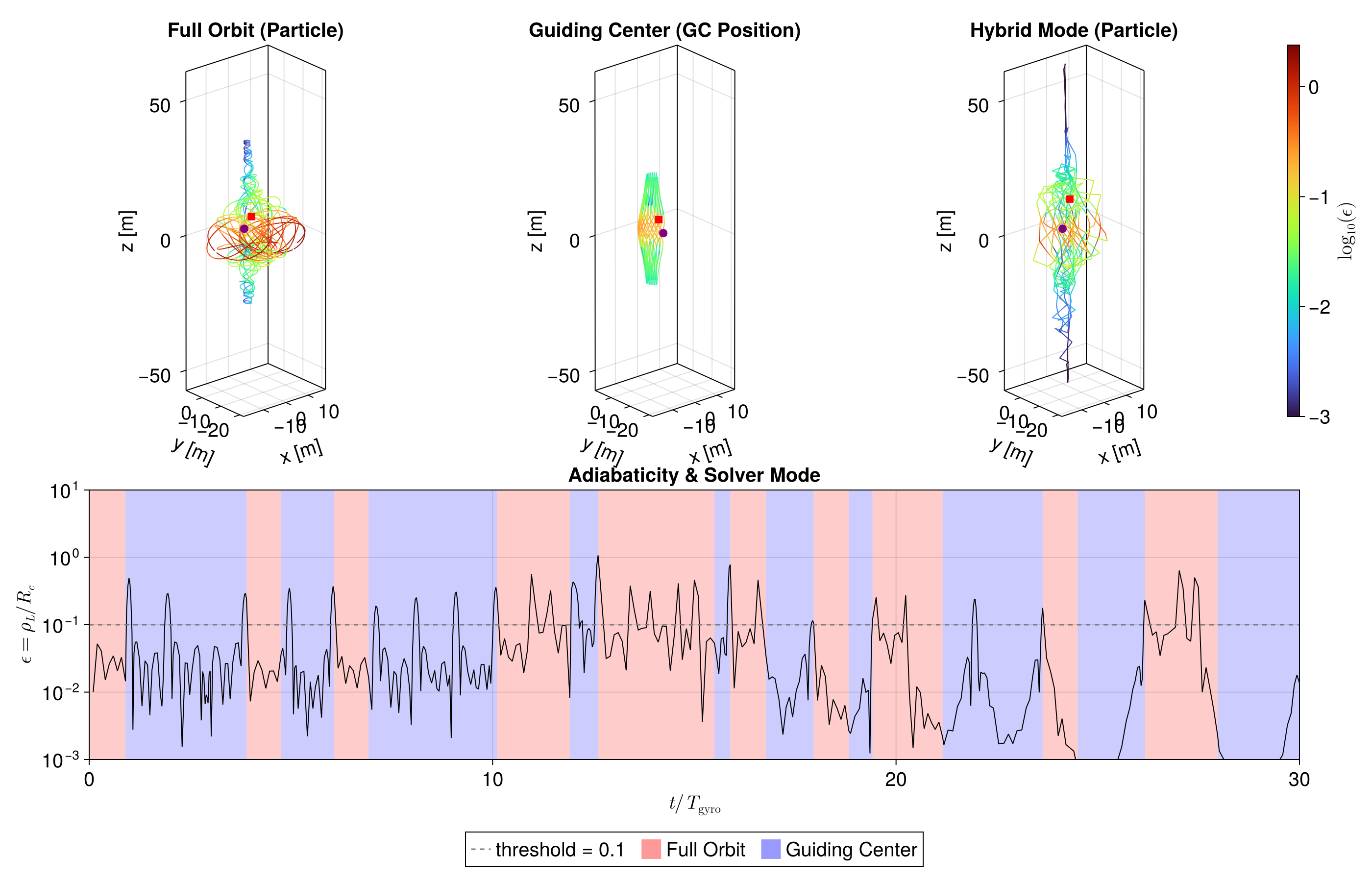
Performance Comparison
Finally, we compare the execution time and memory allocations of the three solvers.
b_fo = @be solve(prob_fo, Vern6())
b_gc = @be solve(prob_gc, Vern6())
b_hy = @be solve(prob_hybrid, alg; verbose = false)

Printf.@printf(
    io, "| Full Orbit | %.2f μs | %.2f KiB |\n",
    median(b_fo).time * 1.0e6, median(b_fo).bytes / 1024
Printf.@printf(
    io, "| Guiding Center | %.2f μs | %.2f KiB |\n",
    median(b_gc).time * 1.0e6, median(b_gc).bytes / 1024
Printf.@printf(
    io, "| Hybrid | %.2f μs | %.2f KiB |\n",
median(b_hy).time * 1.0e6, median(b_hy).bytes / 1024| Solver | Time | Allocations |
|---|---|---|
| Full Orbit | 160.62 μs | 308.02 KiB |
| Guiding Center | 355.20 μs | 341.87 KiB |
| Hybrid | 236.93 μs | 65.00 KiB |
AdaptiveHybrid: Adiabaticity Check Modes
AdaptiveHybrid lets the user pick which adiabaticity criterion drives the GC ↔ FO decision, via the adiabaticity keyword:
:curvature(default) →ε_curv = ρ_L / R_c(curvature drift; reproduces the legacy behaviour),:gradB→ε_gradB = ρ_L / L_B, withL_B = |B| / |∇B|,:both→ OR of the two criteria: switch to full orbit whenever eitherε_curv ≥ αorε_gradB ≥ α(equivalentlymax(ε_curv, ε_gradB) ≥ α),:jacobian→ε_jac = ρ_L · ‖JB‖_F / |B|, all-in-one criterion, which also captures torsion and shear.
All three solve the same problem; they differ only in when the solver drops into the full-orbit mode, so the trajectories stay close while the time spent in each mode changes.
mode_threshold = 0.1
mode_common = (;
    threshold = mode_threshold, dtmax = T_gyro,
    dtmin = 1.0e-4 * T_gyro, maxiters = 500_000, check_interval = 10,
)
alg_curv = AdaptiveHybrid(; mode_common..., adiabaticity = :curvature)
alg_gradB = AdaptiveHybrid(; mode_common..., adiabaticity = :gradB)
alg_both = AdaptiveHybrid(; mode_common..., adiabaticity = :both)

prob_mode = TraceHybridProblem(u0, tspan, p)
sol_curv = solve(prob_mode, alg_curv; verbose = false, seed = 1234).u[1]
sol_gradB = solve(prob_mode, alg_gradB; verbose = false, seed = 1234).u[1]
sol_both = solve(prob_mode, alg_both; verbose = false, seed = 1234).u[1];
RMS position error vs the full-orbit reference, and the FO-mode fraction.
function _adia_rms(sol)
    errs = Float64[]
    for (t, u) in zip(sol.t, sol.u)
        u_ref = sol_fo(t)
        push!(errs, norm(u[1:3] - u_ref[1:3]))
    end
    return sqrt(mean(errs .^ 2))
end
function _adia_fo_frac(sol)
    mode = sol.stats.adiabaticity.mode
    return count(==(:FO), mode) / length(mode)
end

ε_col_curv = get_adiabaticity(sol_curv)
ε_col_gradB = get_adiabaticity(sol_gradB)
ε_col_both = get_adiabaticity(sol_both)

Printf.@printf(
    io2, "| `:curvature` | %.2f | %d | %.2e |\n",
    _adia_fo_frac(sol_curv), length(sol_curv.t), _adia_rms(sol_curv)
Printf.@printf(
    io2, "| `:gradB` | %.2f | %d | %.2e |\n",
    _adia_fo_frac(sol_gradB), length(sol_gradB.t), _adia_rms(sol_gradB)
Printf.@printf(
    io2, "| `:both` | %.2f | %d | %.2e |\n",
    _adia_fo_frac(sol_both), length(sol_both.t), _adia_rms(sol_both)
Result vs full-orbit reference
| Mode | FO fraction | Saved points | RMS pos. err [m] |
|---|---|---|---|
:curvature | 0.33 | 437 | 2.48e+01 |
:gradB | 0.74 | 342 | 5.75e+01 |
:both | 1.00 | 301 | 1.94e+01 |
Trajectories under the three modes
The three modes trace nearly the same path (all stay close to the full-orbit reference); they differ in when the solver drops into the full-orbit mode.
f_modes = Figure(; size = (1400, 460), fontsize = 20)

lms = let
    lx = (Inf, -Inf)
    ly = (Inf, -Inf)
    lz = (Inf, -Inf)
    for s in (sol_curv, sol_gradB, sol_both)
        for u in s.u
            lx = (min(lx[1], u[1]), max(lx[2], u[1]))
            ly = (min(ly[1], u[2]), max(ly[2], u[2]))
            lz = (min(lz[1], u[3]), max(lz[2], u[3]))
        end
    end
    (lx, ly, lz)
end

ax_c = Axis3(
    f_modes[1, 1], title = ":curvature", aspect = :data, limits = lms,
    xlabel = "x [m]", ylabel = "y [m]", zlabel = "z [m]"
)
plot_trajectory!(ax_c, sol_curv, ε_col_curv)

ax_g = Axis3(
    f_modes[1, 2], title = ":gradB", aspect = :data, limits = lms,
    xlabel = "x [m]", ylabel = "y [m]", zlabel = "z [m]"
)
plot_trajectory!(ax_g, sol_gradB, ε_col_gradB)

ax_b = Axis3(
    f_modes[1, 3], title = ":both", aspect = :data, limits = lms,
    xlabel = "x [m]", ylabel = "y [m]", zlabel = "z [m]"
)
plot_trajectory!(ax_b, sol_both, ε_col_both)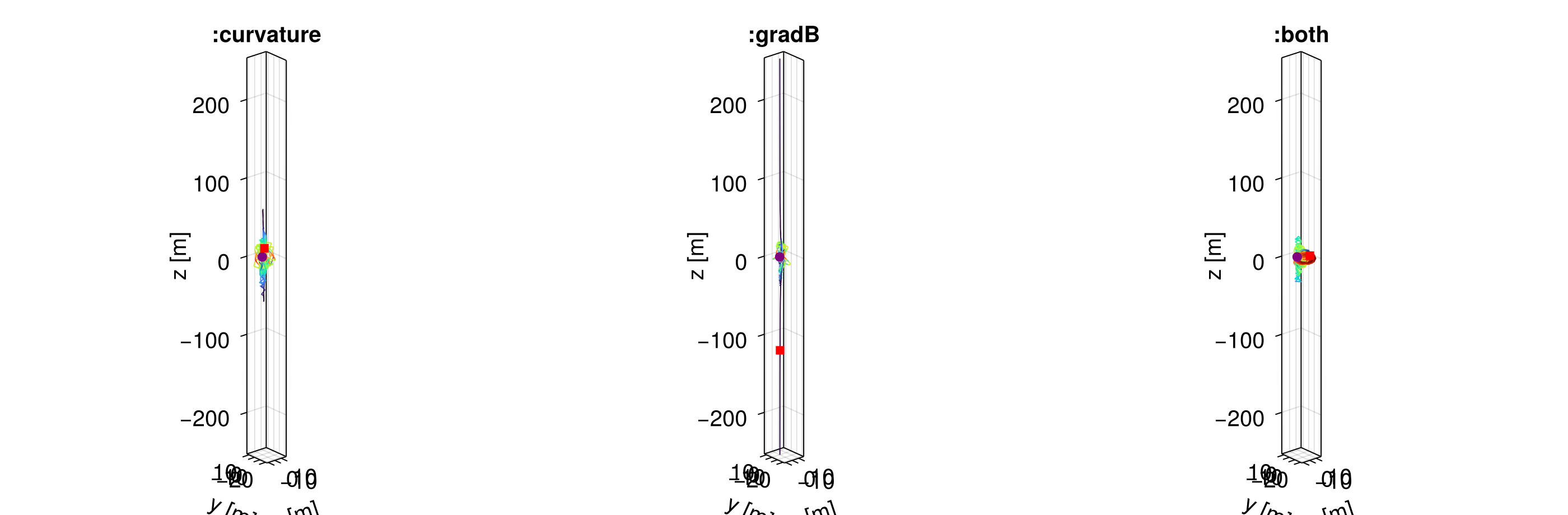
Why the modes differ: the selected adiabaticity
The diagnostics store only the adiabaticity value used by the selected mode (one scalar per check point), not the full component vector. For :curvature and :gradB that is ε_curv and ε_gradB; for :both it is max(ε_curv, ε_gradB). Plotting the stored value for each mode shows that :both switches at least as often as either single criterion alone.
function _adia_traces(sol)
    t = sol.stats.adiabaticity.t ./ T_gyro
    ε = sol.stats.adiabaticity.components
    mode = sol.stats.adiabaticity.mode
    return t, ε, mode
end
t_curv, ε_curv, mode_curv = _adia_traces(sol_curv)
t_gradB, ε_gradB, mode_gradB = _adia_traces(sol_gradB)
t_both, ε_both, mode_both = _adia_traces(sol_both)

f_comp = Figure(; size = (1000, 480), fontsize = 20)
ax_comp = Axis(
    f_comp[1, 1],
    xlabel = L"t / T_\text{gyro}",
    ylabel = L"\epsilon",
    yscale = log10,
    title = "Selected adiabaticity by mode",
    limits = (
        (0.0, 30.0),
        (ε_clamp_lo, 10.0),
    ),
)

# Shade full-orbit (red) vs guiding-center (blue) regions for each mode.
function _shade!(ax, t, mode)
    i = 1
    while i <= length(t)
        m_fo = mode[i] === :FO
        j = i
        while j < length(t) && mode[j + 1] === mode[i]
            j += 1
        end
        c = m_fo ? (:red, 0.18) : (:blue, 0.18)
        vspan!(ax, t[i], t[j]; color = c)
        i = j + 1
    end
    return
end
_shade!(ax_comp, t_curv, mode_curv)
_shade!(ax_comp, t_gradB, mode_gradB)
_shade!(ax_comp, t_both, mode_both)

lines!(ax_comp, t_curv, ε_curv; color = :green, label = ":curvature (ε_curv)")
lines!(ax_comp, t_gradB, ε_gradB; color = :orange, label = ":gradB (ε_gradB)")
lines!(ax_comp, t_both, ε_both; color = :black, linewidth = 1.6, label = ":both (max)")
hlines!(
    ax_comp, [mode_threshold];
    color = :gray50, linestyle = :dash, linewidth = 1.5,
    label = "threshold = $(round(mode_threshold; sigdigits = 2))"
)
axislegend(ax_comp; position = :rt)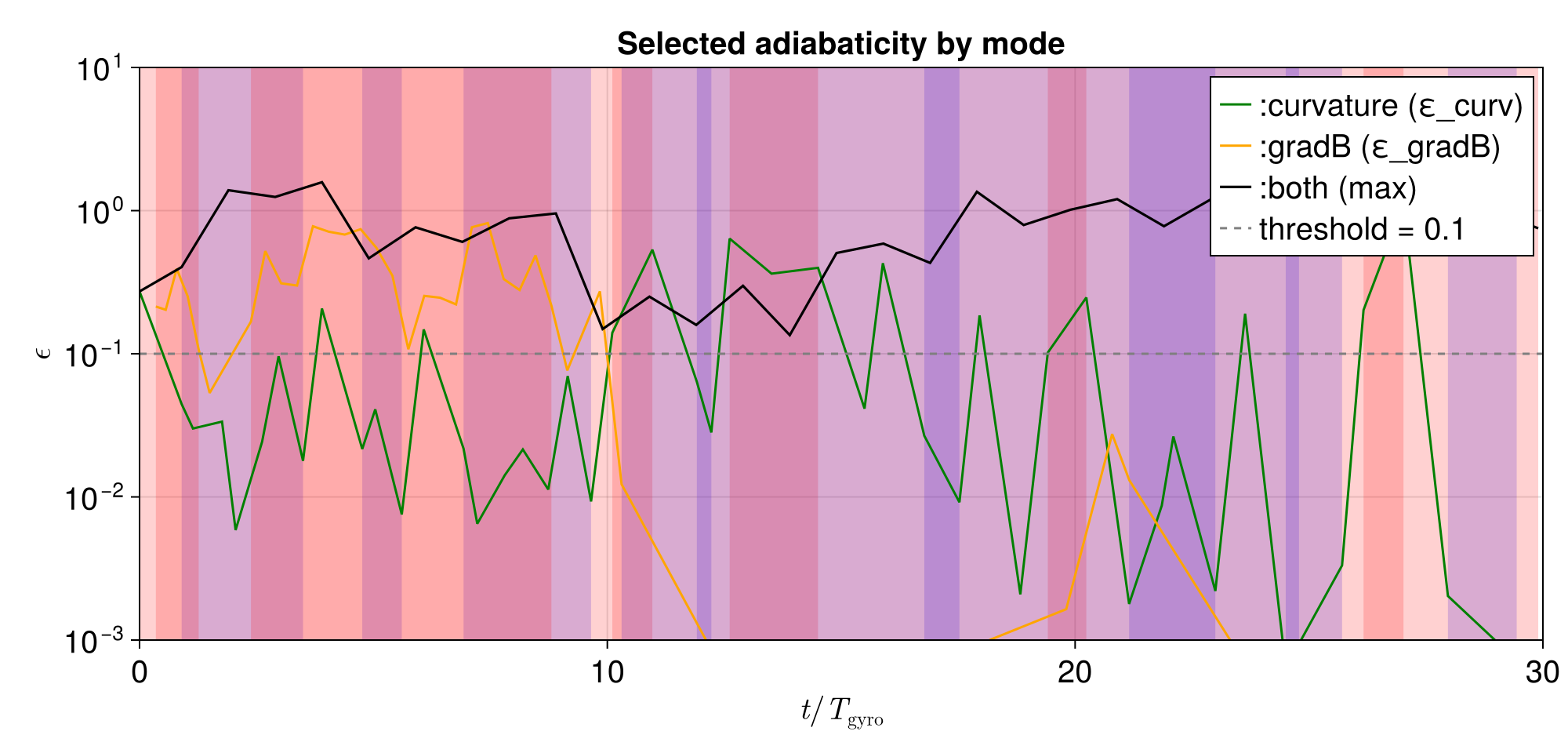
Performance
All three modes share the same solver core; :curvature carries only a few KiB of extra diagnostics. The :gradB / :both modes can even run faster in this setup because they spend more time in the cheap Boris full-orbit integrator, at the cost of higher memory (more saved points).
b_curv = @be solve($prob_mode, $alg_curv; verbose = false, seed = 1234)
b_gradB = @be solve($prob_mode, $alg_gradB; verbose = false, seed = 1234)
b_both = @be solve($prob_mode, $alg_both; verbose = false, seed = 1234)

Printf.@printf(
    io3, "| `:curvature` | %.2f ms | %.2f KiB |\n",
    median(b_curv).time * 1.0e3, median(b_curv).bytes / 1024
Printf.@printf(
    io3, "| `:gradB` | %.2f ms | %.2f KiB |\n",
    median(b_gradB).time * 1.0e3, median(b_gradB).bytes / 1024
Printf.@printf(
    io3, "| `:both` | %.2f ms | %.2f KiB |\n",
median(b_both).time * 1.0e3, median(b_both).bytes / 1024| Mode | Time | Allocations |
|---|---|---|
:curvature | 0.21 ms | 65.39 KiB |
:gradB | 0.07 ms | 58.59 KiB |
:both | 0.01 ms | 20.52 KiB |