
Relativistic vs Non-relativistic Tracing
This example compares the particle trajectories of trace! (non-relativistic) and trace_relativistic! (relativistic) solvers. We demonstrate two cases:
Uniform magnetic field (Cyclotron motion)
Uniform ExB field (ExB drift)
Relativistic effects become significant when the particle velocity approaches the speed of light
using TestParticle
using OrdinaryDiffEq
using StaticArrays
using CairoMakie
Case 1: Pure Magnetic Field (Cyclotron Motion)
We trace protons in a uniform magnetic field
Field and Particle Setup
const B0 = 1.0 # [T]
getB1(x) = SA[0.0, 0.0, B0]
getE1(x) = SA[0.0, 0.0, 0.0]

m = TestParticle.mᵢ
q = TestParticle.qᵢ
c = TestParticle.c

param = prepare(getE1, getB1; species = Proton);
Initial velocities to test: 10%, 50%, and 90% of speed of light
rats = [0.1, 0.5, 0.9]
v_ratios = [rat * c for rat in rats]
labels = ["0.1c", "0.5c", "0.9c"]
colors = [:darkcyan, :orange, :red];
Time span: enough for a few gyro-periods. Using the non-relativistic cyclotron period as a baseline reference.
Ω_non = q * B0 / m
T_non = 2π / Ω_non
tspan = (0.0, 4 * T_non);
Simulation and Plotting
f1 = Figure(size = (600, 600), fontsize = 20)
ax1 = Axis(
    f1[1, 1],
    title = "Trajectory comparison (XY plane)",
    xlabel = "x [m]", ylabel = "y [m]", aspect = DataAspect()
)

for (i, v_mag) in enumerate(v_ratios)
    # Let's start at same point (0,0,0) with v in x-dir.
    r0 = [0.0, 0.0, 0.0]
    v0 = [v_mag, 0.0, 0.0]

    # Non-relativistic initial state: [r, v]
    u0_non = [r0..., v0...]
    prob_non = ODEProblem(trace!, u0_non, tspan, param)
    sol_non = solve(prob_non, Vern7())

    # Relativistic initial state: [r, γv]
    γ = 1 / sqrt(1 - (v_mag / c)^2)
    u0_rel = [r0..., (γ * v0)...]
    prob_rel = ODEProblem(trace_relativistic!, u0_rel, tspan, param)
    sol_rel = solve(prob_rel, Vern7())

    # Plot
    lines!(
        ax1, sol_non; idxs = (1, 2), linestyle = :dash,
        color = colors[i], label = "Non-rel $(labels[i])"
    )
    lines!(
        ax1, sol_rel; idxs = (1, 2), linestyle = :solid,
        color = colors[i], label = "Rel $(labels[i])"
    )
end

axislegend(ax1; position = :rt, backgroundcolor = :transparent)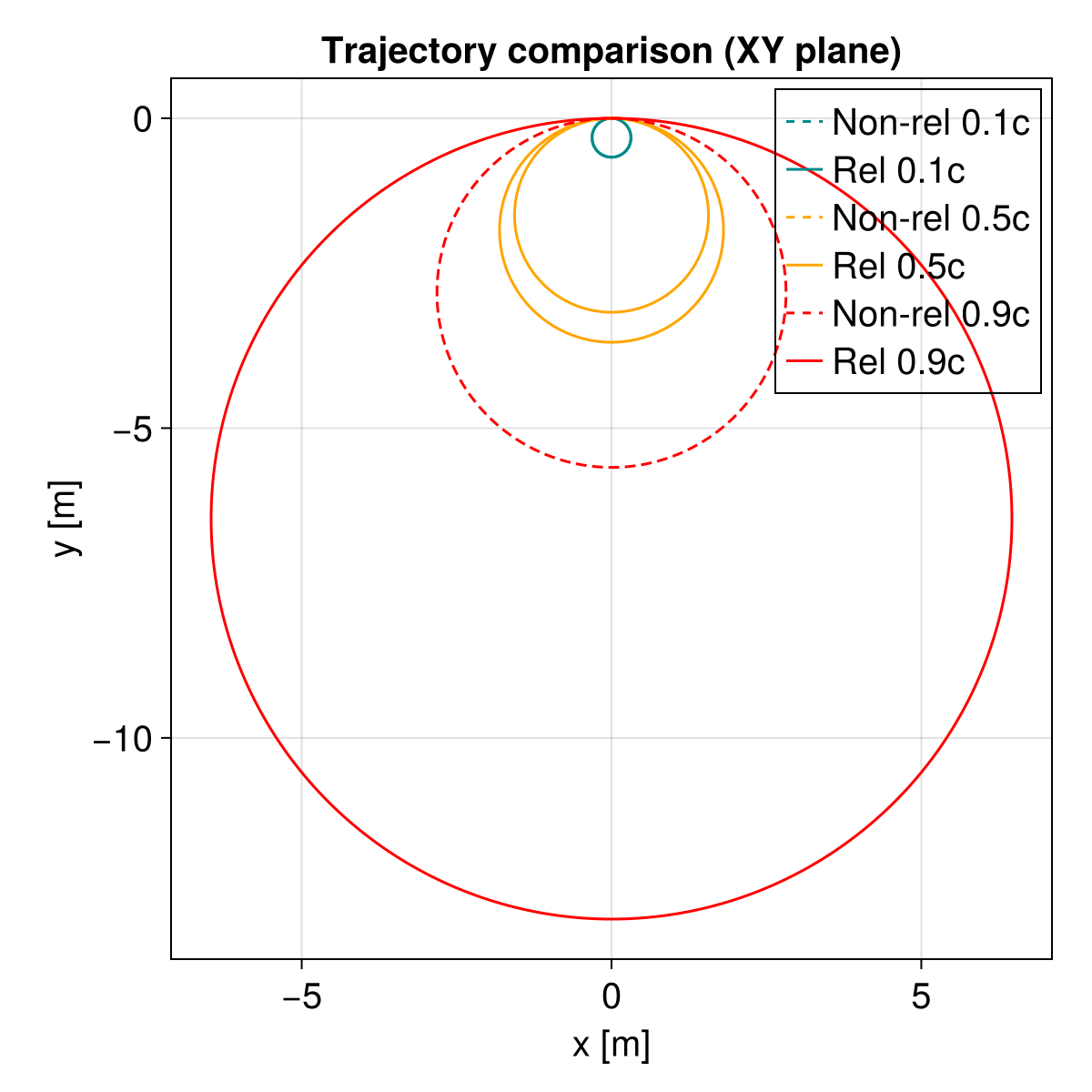
Observation: At 0.1c, the dashed and solid lines almost overlap. At 0.9c, the relativistic trajectory (solid) has a significantly larger radius, consistent with the factor of γ ≈ 2.29 increase in effective mass.
Case 2: ExB Drift
We add a uniform electric field
const E0 = 0.5 * c * B0 # strong electric field, v_drift = 0.5c
getB2(x) = SA[0.0, 0.0, B0]
getE2(x) = SA[0.0, E0, 0.0]

param2 = prepare(getE2, getB2; species = Proton);
Test with a single high initial velocity perpendicular to drift to see the cycloid differences. Starting from rest: Non-relativistic: cycloid with peak velocity 2*v_drift. Relativistic: should also drift but with different dynamics.
v_init_mag = 0.0 # start from rest
r0 = [0.0, 0.0, 0.0]
v0 = [0.0, v_init_mag, 0.0];
Non-relativistic
u0_non = [r0..., v0...]
prob_non_drift = ODEProblem(trace!, u0_non, tspan, param2)
sol_non_drift = solve(prob_non_drift, Vern7());
Relativistic if v=0, γ=1
u0_rel = [r0..., v0...]
prob_rel_drift = ODEProblem(trace_relativistic!, u0_rel, tspan, param2)
sol_rel_drift = solve(prob_rel_drift, Vern7());
Trajectory comparison
f2 = Figure(size = (1000, 300), fontsize = 20)
ax2 = Axis(
    f2[1, 1],
    title = "ExB Drift comparison (XY plane)",
    xlabel = "x [m]", ylabel = "y [m]", aspect = DataAspect()
)

lines!(
    ax2, sol_non_drift; idxs = (1, 2), linestyle = :dash,
    color = :darkcyan, label = "Non-rel drift"
)
lines!(
    ax2, sol_rel_drift; idxs = (1, 2), linestyle = :solid,
    color = :darkorange, label = "Rel drift"
)

axislegend(ax2; position = :rb, backgroundcolor = :transparent)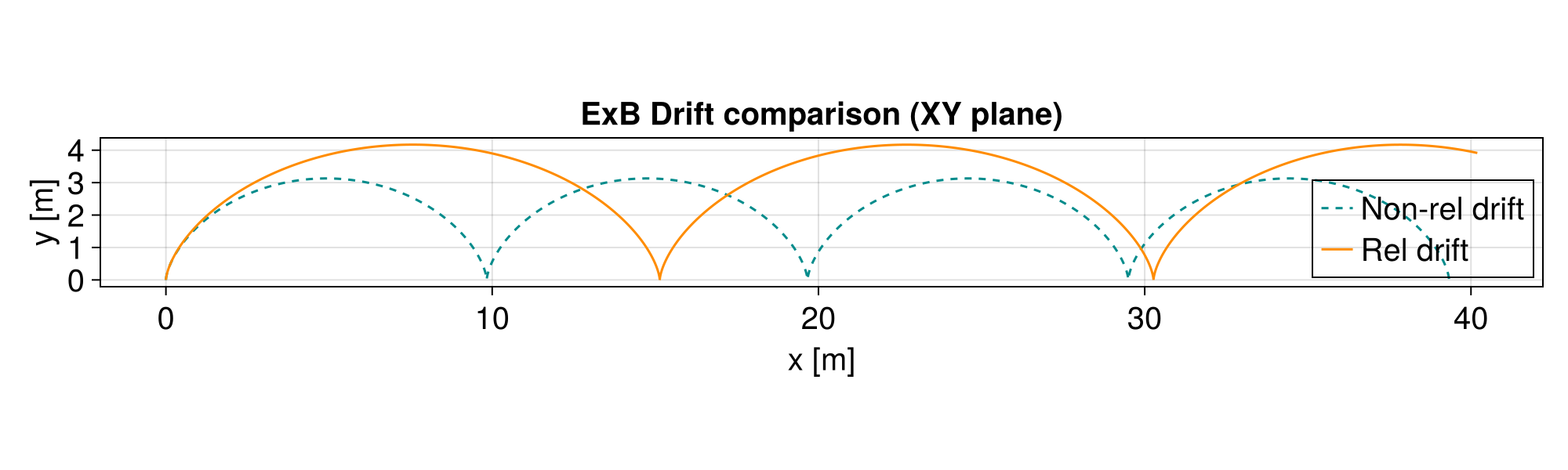
Summary
Case 1: Relativistic particles have larger gyroradii due to the relativistic factor
. Case 2: Under strong electric fields, relativistic kinematics limit the velocity to
, whereas non-relativistic dynamics would predict velocities exceeding (if is large enough or during the gyro-phase).