
Adiabatic Invariants Periods
This example demonstrates the three characteristic time scales (periods) associated with the three adiabatic invariants of charged particle motion in a dipole field:
Gyro-motion: The rapid rotation around the magnetic field lines.
Bounce motion: The oscillation between magnetic mirror points along the field line.
Drift motion: The slow azimuthal drift around the Earth.
We calculate these periods theoretically and verify them numerically using TestParticle.jl.
using TestParticle
import TestParticle as TP
using TestParticle: sph2cart, Rₑ, mᵢ, qᵢ, c
import Magnetostatics as MS
using OrdinaryDiffEq
using LinearAlgebra
using Statistics
using CairoMakie
Theoretical Estimates
For a proton in Earth's dipole field, we can estimate the three periods.
The magnetic field strength at the equator for L-shell
The gyro-period is
The bounce period is approximately
The drift period is approximately
# Parameters
L = 2.5             # L-shell
Ek_MeV = 10.0       # Kinetic energy in MeV
α_eq = deg2rad(30)  # Equatorial pitch angle
B₀ = 3.12e-5        # Dipole moment magnitude [T]

# Constants
Ek = Ek_MeV * 1.0e6 * 1.602e-19 # Energy in Joules
γ = 1 + Ek / (mᵢ * c^2)
v = c * sqrt(1 - 1 / γ^2)       # Velocity [m/s]
B_eq = B₀ / L^3               # Equatorial field [T]

# Theoretical periods
# 1. Gyro period (at equator)
Ω_eq = qᵢ * B_eq / (mᵢ * γ)
τ_g_theo = 2π / Ω_eq

# 2. Bounce period
τ_b_theo = 4 * L * Rₑ / v * (1.3 - 0.56 * sin(α_eq))

# 3. Drift period
# Relativistic correction factor for drift?
# Gradient drift v_d = ...
# Using approximation from literature (usually non-relativistic but we can adjust mass).
# Let's use the standard approximate formula.
τ_d_theo = 2π * qᵢ * B₀ * Rₑ^2 / (3 * mᵢ * γ * v^2 * L * (0.35 + 0.15 * sin(α_eq)))

println("Theoretical Gyro Period (Equator): $(round(τ_g_theo, digits = 4)) s")
println("Theoretical Bounce Period:         $(round(τ_b_theo, digits = 4)) s")
println("Theoretical Drift Period:          $(round(τ_d_theo, digits = 4)) s")
Theoretical Gyro Period (Equator): 0.0332 s
Theoretical Bounce Period: 1.4966 s
Theoretical Drift Period: 125.4911 sNumerical Simulation
We simulate the particle trajectory using Vern9 solver.
# Initial condition
r₀ = sph2cart(L * Rₑ, π / 2, 0.0) # Equatorial plane, theta=pi/2, phi=0
vmag = v
# The dipole field at the equator points in the -z direction.
# To have a pitch angle of α_eq, we need the angle between v and -z to be α_eq.
# v_x = 0 (radial), v_y = v_perp (azimuthal), v_z = v_para (field-aligned)
v₀ = [0.0, vmag * sin(α_eq), -vmag * cos(α_eq)]

stateinit = [r₀..., v₀...]
Bfield = MS.Dipole(TP.BMoment_Earth)
param = prepare(ZeroField(), r -> Bfield(r))
tspan = (0.0, 1.2 * τ_d_theo) # Run for slightly more than one drift period

prob = ODEProblem(trace!, stateinit, tspan, param)
sol = solve(prob, Vern9(); reltol = 1.0e-6, maxiters = 1.0e8);
Analysis and Visualization
# Extract positions
t = sol.t
x = sol[1, :]
y = sol[2, :]
z = sol[3, :]
70121-element Vector{Float64}:
9.752780946709735e-10
-0.015936994577149734
-0.08116141315587264
-0.2937314275815297
-1.0454629066124035
-3.4203072976463686
-11.54703830089256
-37.66873731058627
-122.71462393088046
-398.7722124582405
⋮
6.059924086856891e6
6.113700035083827e6
6.153596042592574e6
6.157014687360688e6
6.122777005343169e6
6.069448156507198e6
6.034252763027477e6
6.03668667843558e6
6.044729624665073e61. Gyro Motion
Zoom in on a small segment at the beginning. Note that here we show the raw output; a more smoothed version can be shown via interpolation.
idx_zoom = 1:min(length(t), 50)
f1 = Figure(size = (800, 400))
ax1 = Axis(
    f1[1, 1], title = "Gyro Motion (Zoom)", xlabel = "x [Rₑ]",
    ylabel = "y [Rₑ]", aspect = DataAspect()
)
lines!(ax1, x[idx_zoom] ./ Rₑ, y[idx_zoom] ./ Rₑ)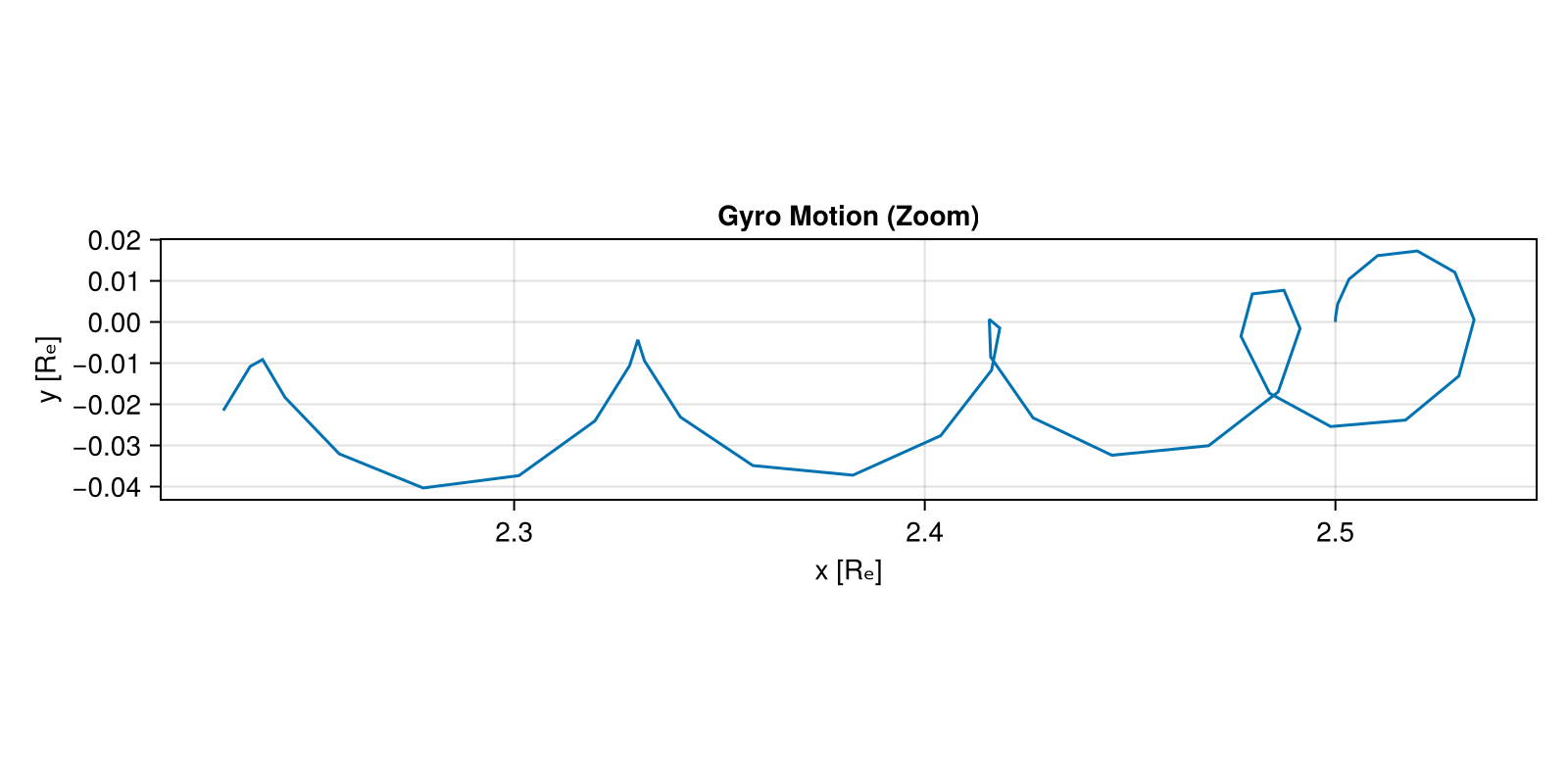
These does not look like full circles because the dipole field lines are curved, and as we move away from the equatorial plane, the perpendicular plane is no longer aligned with the X-Y plane.
2. Bounce Motion
Plot z-coordinate vs time to see bouncing.
f2 = Figure(size = (800, 400))
ax2 = Axis(f2[1, 1], title = "Bounce Motion", xlabel = "Time [s]", ylabel = "z [Rₑ]")
idx_bounce = t .< 10 * τ_b_theo
lines!(ax2, t[idx_bounce], z[idx_bounce] ./ Rₑ)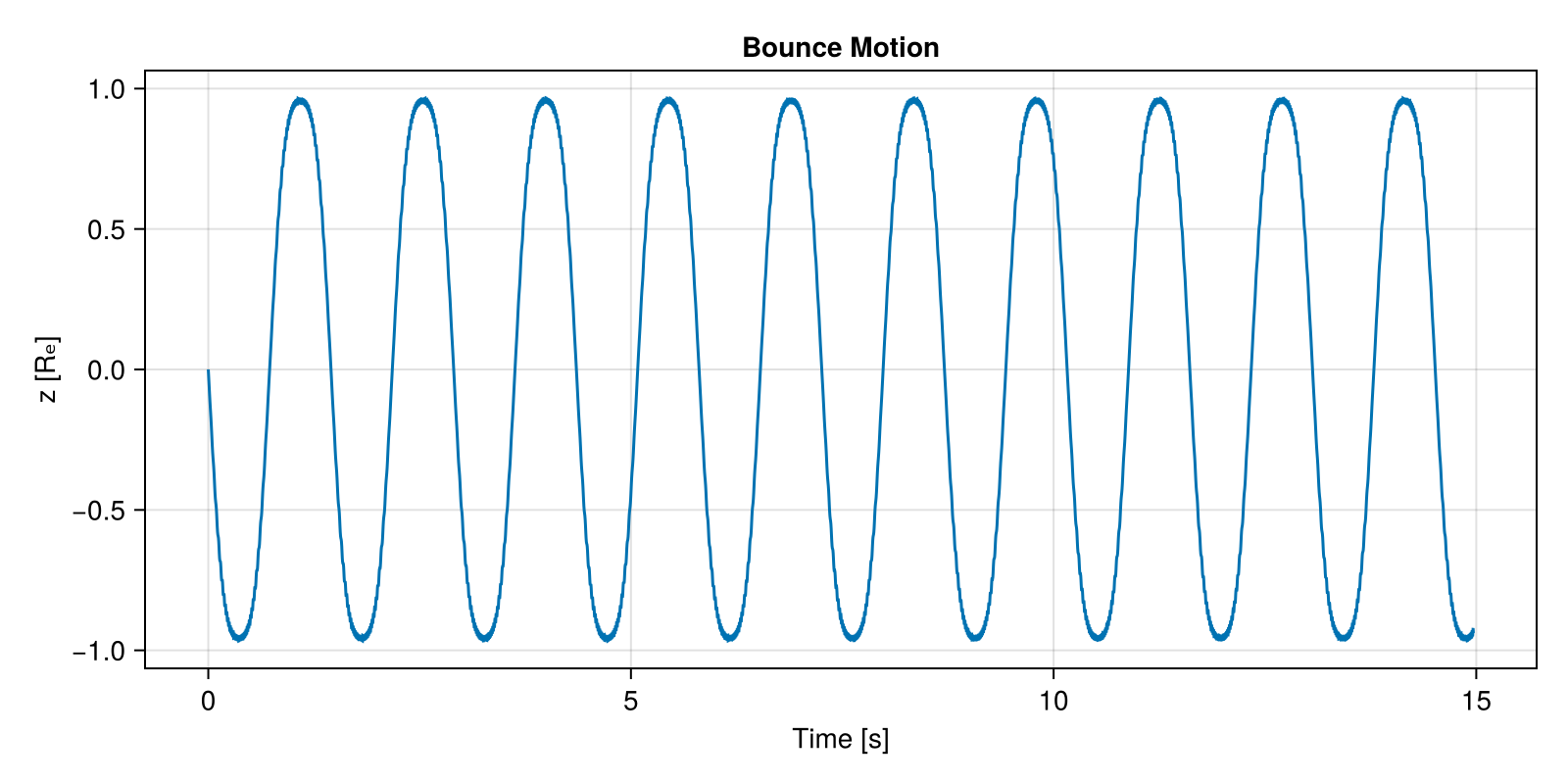
Calculate Bounce Period from z-crossings Find indices where z crosses 0 (approx).
signs = sign.(z)
crossings = findall(diff(signs) .!= 0)
if length(crossings) > 2
    t_cross = t[crossings]
    # Time between every second crossing is one period.
    τ_b_sim = mean(diff(t_cross)[1:2:(end - 1)]) * 2
    println("Simulated Bounce Period: $τ_b_sim s")
else
    println("Not enough bounces to estimate period.")
    τ_b_sim = NaN
end
Simulated Bounce Period: 1.4520266008384977 s3. Drift Motion
# Plot x-y trajectory.
f3 = Figure(size = (600, 600))
ax3 = Axis(
    f3[1, 1], title = "Drift Motion (Azimuthal)",
    xlabel = "x [Rₑ]", ylabel = "y [Rₑ]", aspect = DataAspect()
)
lines!(ax3, x ./ Rₑ, y ./ Rₑ)
# Draw Earth
theta = LinRange(0, 2π, 100)
lines!(ax3, cos.(theta), sin.(theta), color = :black, linestyle = :dash)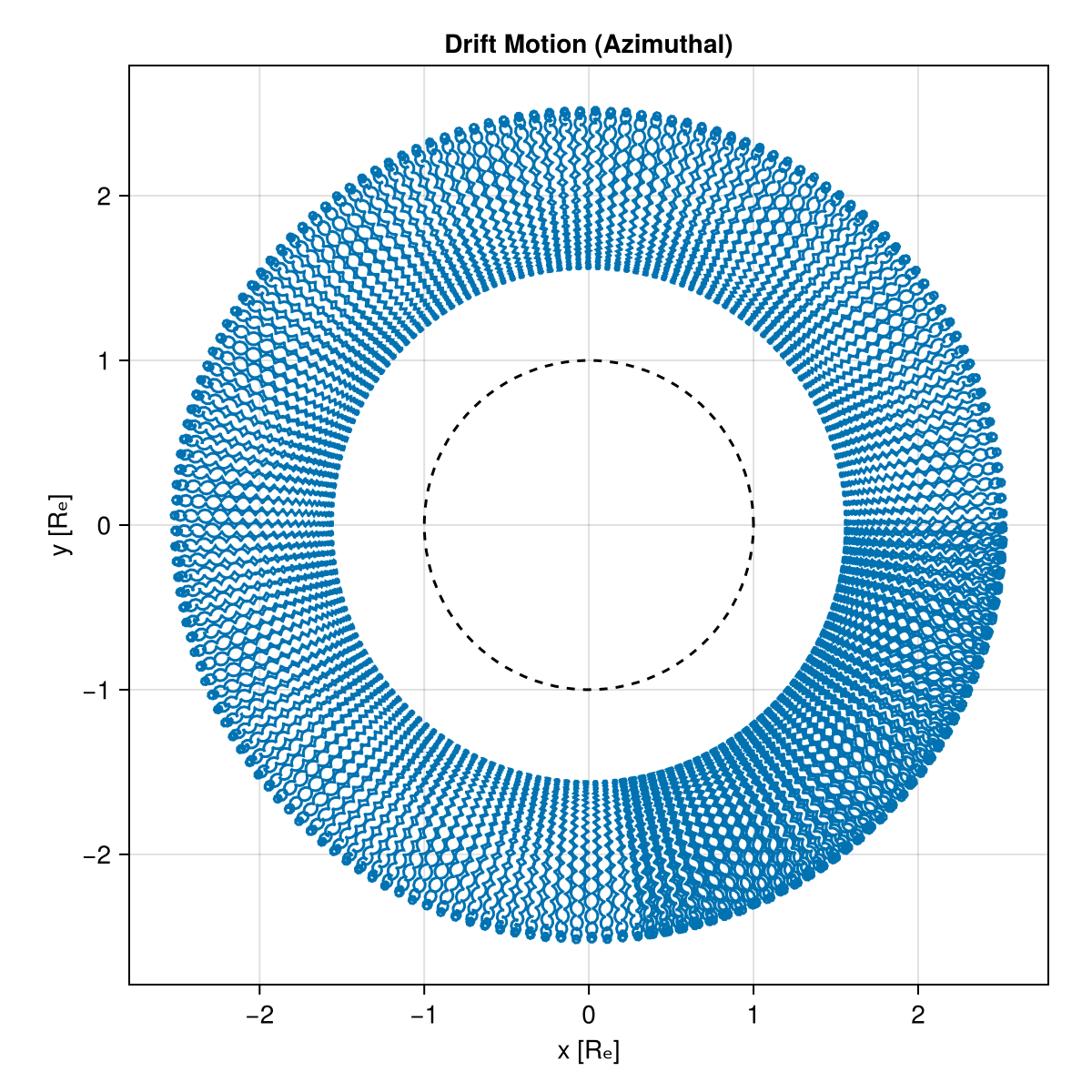
Calculate Drift Period
# Calculate azimuthal angle phi, unwrap phi
phi_unwrap = let offset = 0.0
    phi = atan.(y, x)
    phi_unwrap = copy(phi)
    for i in eachindex(phi)[2:end]
        dphi = phi[i] - phi[i - 1]
        if dphi > π
            offset -= 2π
        elseif dphi < -π
            offset += 2π
        end
        phi_unwrap[i] += offset
    end
    phi_unwrap
end

# Fit line to phi vs t
# Slope is drift frequency.
slope = (phi_unwrap[end] - phi_unwrap[1]) / (t[end] - t[1])
τ_d_sim = abs(2π / slope)
println("Simulated Drift Period: $τ_d_sim s")
Simulated Drift Period: 122.54273418501862 sComparison table
| Period | Theoretical | Simulated |
|---|---|---|
| Gyro | 0.0332 | N/A (varies) |
| Bounce | 1.4966 | 1.452 |
| Drift | 125.4911 | 122.5427 |