
Performance Benchmark
This example compares the performance of the native Boris method against various ODE solvers from OrdinaryDiffEq.jl. We use Chairmarks.jl for benchmarking.
using Chairmarks
using TestParticle
using OrdinaryDiffEq, OrdinaryDiffEqRosenbrock, OrdinaryDiffEqSDIRK
using StaticArrays
using CairoMakie
using Statistics
import TestParticle as TP
Simulation Setup
We use a simple setup: an electron in a uniform magnetic field.
const Bmag = 0.01
uniform_B(x) = SA[0.0, 0.0, Bmag]
zero_E = ZeroField()

x0 = SA[0.0, 0.0, 0.0]
v0 = SA[0.0, 1.0e5, 0.0]
stateinit = SA[x0..., v0...]
# (q2m, m, E, B, F)
param = prepare(zero_E, uniform_B, species = Electron)
q2m = TP.get_q2m(param)

# Reference parameters
const tperiod = 2π / (abs(q2m) * Bmag)

tspan = (0.0, 400 * tperiod)
dt = tperiod / 12

prob_boris = TraceProblem(stateinit, tspan, param)
# ODE solvers from DifferentialEquations.jl are optimized for StaticArrays (SVector)
prob_ode = ODEProblem(trace, stateinit, tspan, param)
ODEProblem with uType StaticArraysCore.SVector{6, Float64} and tType Float64. In-place: false
Non-trivial mass matrix: false
timespan: (0.0, 1.428954701151284e-6)
u0: 6-element StaticArraysCore.SVector{6, Float64} with indices SOneTo(6):
0.0
0.0
0.0
0.0
100000.0
0.0Benchmark
We benchmark the following solvers:
solvers = [
    ("Boris (n=1, N=2)", "standard Boris (n=1, N=2)", :Boris, () -> solve(prob_boris, Boris(); dt)),
    ("Boris (n=2, N=2)", "2-cycled (n=2, N=2)", :Boris, () -> solve(prob_boris, MultistepBoris2(; n = 2); dt)),
    ("Boris (n=4, N=2)", "4-cycled (n=4, N=2)", :Boris, () -> solve(prob_boris, MultistepBoris2(; n = 4); dt)),
    ("Boris (n=1, N=6)", "6-th order Boris (n=1, N=6)", :Boris, () -> solve(prob_boris, MultistepBoris6(; n = 1); dt)),
    ("Boris (n=2, N=6)", "Hyper Boris (n=2, N=6)", :Boris, () -> solve(prob_boris, MultistepBoris6(; n = 2); dt)),
    ("Boris (n=4, N=6)", "Hyper Boris (n=4, N=6)", :Boris, () -> solve(prob_boris, MultistepBoris6(; n = 4); dt)),
    ("Tsit5 (fixed)", "`OrdinaryDiffEq` Tsit5 with fixed step", :Fixed, () -> solve(prob_ode, Tsit5(); adaptive = false, dt, dense = false)),
    ("Tsit5 (adaptive)", "`OrdinaryDiffEq` Tsit5 with adaptive step", :Adaptive, () -> solve(prob_ode, Tsit5(); saveat = dt)),
    ("Vern7 (fixed)", "`OrdinaryDiffEq` Vern7 with fixed step", :Fixed, () -> solve(prob_ode, Vern7(); adaptive = false, dt, dense = false)),
    ("Vern7 (adaptive)", "`OrdinaryDiffEq` Vern7 with adaptive step", :Adaptive, () -> solve(prob_ode, Vern7(); saveat = dt)),
    ("Vern9 (fixed)", "`OrdinaryDiffEq` Vern9 with fixed step", :Fixed, () -> solve(prob_ode, Vern9(); adaptive = false, dt, dense = false)),
    ("Vern9 (adaptive)", "`OrdinaryDiffEq` Vern9 with adaptive step", :Adaptive, () -> solve(prob_ode, Vern9(); saveat = dt)),
    ("AutoVern7 (adaptive)", "`OrdinaryDiffEq` AutoVern7 with adaptive step", :Adaptive, () -> solve(prob_ode, AutoVern7(Rodas5()); saveat = dt)),
    ("AutoVern9 (adaptive)", "`OrdinaryDiffEq` AutoVern9 with adaptive step", :Adaptive, () -> solve(prob_ode, AutoVern9(Rodas5()); saveat = dt)),
    ("ImplicitMidpoint", "`OrdinaryDiffEq` ImplicitMidpoint with fixed step", :Fixed, () -> solve(prob_ode, ImplicitMidpoint(); adaptive = false, dt, dense = false)),
]| Solver | Description |
|---|---|
| Boris (n=1, N=2) | standard Boris (n=1, N=2) |
| Boris (n=2, N=2) | 2-cycled (n=2, N=2) |
| Boris (n=4, N=2) | 4-cycled (n=4, N=2) |
| Boris (n=1, N=6) | 6-th order Boris (n=1, N=6) |
| Boris (n=2, N=6) | Hyper Boris (n=2, N=6) |
| Boris (n=4, N=6) | Hyper Boris (n=4, N=6) |
| Tsit5 (fixed) | OrdinaryDiffEq Tsit5 with fixed step |
| Tsit5 (adaptive) | OrdinaryDiffEq Tsit5 with adaptive step |
| Vern7 (fixed) | OrdinaryDiffEq Vern7 with fixed step |
| Vern7 (adaptive) | OrdinaryDiffEq Vern7 with adaptive step |
| Vern9 (fixed) | OrdinaryDiffEq Vern9 with fixed step |
| Vern9 (adaptive) | OrdinaryDiffEq Vern9 with adaptive step |
| AutoVern7 (adaptive) | OrdinaryDiffEq AutoVern7 with adaptive step |
| AutoVern9 (adaptive) | OrdinaryDiffEq AutoVern9 with adaptive step |
| ImplicitMidpoint | OrdinaryDiffEq ImplicitMidpoint with fixed step |
To simulate realistic applications, we save the solution at fixed intervals for all solvers. For adaptive solvers, the default relative tolerance is 1e-3 and absolute tolerance is 1e-6.
"""
Helper functions to extract the median execution time and memory allocation.
"""
function get_median_time_memory(b)
    mb = median(b)
    return mb.time, mb.bytes
end

n_solvers = length(solvers)
results_time = Vector{Float64}(undef, n_solvers)
results_mem = Vector{Float64}(undef, n_solvers)
names = Vector{String}(undef, n_solvers)
groups = Vector{Symbol}(undef, n_solvers)

for (i, (name, desc, group, func)) in enumerate(solvers)
    println("Benchmarking $name...")
    b = @be $func() seconds = 1
    mt, mm = get_median_time_memory(b)
    results_time[i] = mt
    results_mem[i] = mm
    names[i] = name
    groups[i] = group
end
Benchmarking Boris (n=1, N=2)...
Benchmarking Boris (n=2, N=2)...
Benchmarking Boris (n=4, N=2)...
Benchmarking Boris (n=1, N=6)...
Benchmarking Boris (n=2, N=6)...
Benchmarking Boris (n=4, N=6)...
Benchmarking Tsit5 (fixed)...
Benchmarking Tsit5 (adaptive)...
Benchmarking Vern7 (fixed)...
Benchmarking Vern7 (adaptive)...
Benchmarking Vern9 (fixed)...
Benchmarking Vern9 (adaptive)...
Benchmarking AutoVern7 (adaptive)...
Benchmarking AutoVern9 (adaptive)...
Benchmarking ImplicitMidpoint...Normalize results to the standard Boris method with a fixed timestep
baseline_idx = findfirst(==("Boris (n=1, N=2)"), names)
baseline_time = results_time[baseline_idx]
baseline_mem = results_mem[baseline_idx]

results_time_norm = results_time ./ baseline_time
results_mem_norm = results_mem ./ baseline_mem;
Detailed Performance Comparison
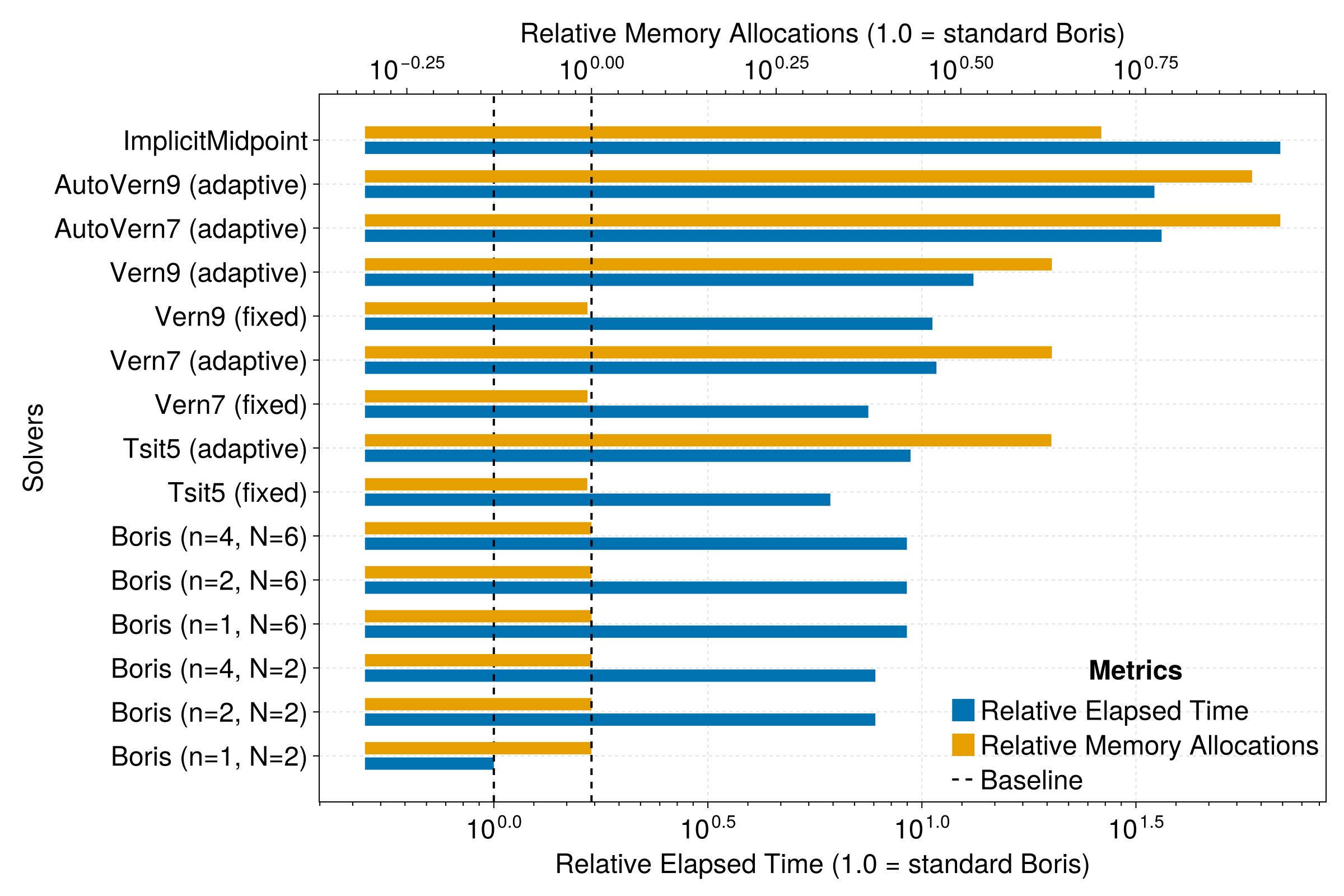
All the results below are normalized to the standard Boris method with a fixed timestep. The absolute cost of this baseline is
t_base = round(baseline_time * 1.0e3; digits = 2)
m_base = round(baseline_mem / 1024; digits = 1)| Solver | Elapsed Time (ms) | Memory Allocations (kB) |
|---|---|---|
| Boris (n=1, N=2) | 0.08 | 307.4 |
A relative value of 1.0 therefore means the same cost as the baseline.
colors = Makie.wong_colors()

f = Figure(size = (1200, 800), fontsize = 24)

y_positions = 1:n_solvers

ax_time = Axis(
    f[1, 1],
    xlabel = "Relative Elapsed Time (1.0 = standard Boris)",
    ylabel = "Solvers",
    yticks = (y_positions, names),
    xscale = log10,
    xgridstyle = :dash,
    ygridstyle = :dash,
    xminorticksvisible = true,
    xminorticks = IntervalsBetween(9)
)

ax_mem = Axis(
    f[1, 1],
    xaxisposition = :top,
    xlabel = "Relative Memory Allocations (1.0 = standard Boris)",
    xscale = log10,
    xgridvisible = false,
    ygridvisible = false,
    yticksvisible = false,
    yticklabelsvisible = false,
    xminorticksvisible = true,
    xminorticks = IntervalsBetween(9)
)

linkyaxes!(ax_time, ax_mem)

bar_width = 0.35
color_time = colors[1]
color_mem = colors[2]

barplot!(
    ax_time, y_positions .- bar_width / 2, results_time_norm;
    direction = :x, width = bar_width, color = color_time
)

# Avoid 0 for log plot
safe_results_mem = max.(results_mem_norm, 1.0e-3)
barplot!(
    ax_mem, y_positions .+ bar_width / 2, safe_results_mem;
    direction = :x, width = bar_width, color = color_mem
)

# Mark the baseline
vlines!(ax_time, [1.0]; color = :black, linestyle = :dash, linewidth = 2)
vlines!(ax_mem, [1.0]; color = :black, linestyle = :dash, linewidth = 2)

elements = [
    PolyElement(polycolor = color_time),
    PolyElement(polycolor = color_mem),
    LineElement(color = :black, linestyle = :dash, linewidth = 2),
]
labels = ["Relative Elapsed Time", "Relative Memory Allocations", "Baseline"]
Legend(
    f[1, 1], elements, labels, "Metrics";
    framevisible = false, halign = :right, valign = :bottom,
    tellwidth = false, tellheight = false
)
Solver Efficiency
Next, we evaluate the solver efficiency by plotting relative time versus relative memory.
f2 = Figure(size = (1200, 800), fontsize = 24)

ax = Axis(
    f2[1, 1],
    title = "Solver Efficiency (Time vs. Memory)",
    xlabel = "Relative Time (1.0 = standard Boris)",
    ylabel = "Relative Memory (1.0 = standard Boris)",
    xgridstyle = :dash,
    ygridstyle = :dash,
    xscale = log10,
    yscale = log10,
    xminorticksvisible = true,
    yminorticksvisible = true,
    xminorticks = IntervalsBetween(9),
    yminorticks = IntervalsBetween(9)
)

# Defined groups and colors
unique_groups = unique(groups)
group_colors = Dict(g => colors[i] for (i, g) in enumerate(unique_groups))

# Marker palette for the individual solvers in each group
marker_palette = [:circle, :rect, :utriangle, :dtriangle, :diamond, :pentagon, :hexagon, :star5, :xcross, :cross]

legend_elements = Vector{Vector{MarkerElement}}()
legend_labels = Vector{Vector{String}}()
legend_titles = String[]

for g in unique_groups
    idxs = findall(==(g), groups)
    group_elements = MarkerElement[]
    group_labels = String[]
    for (i, idx) in enumerate(idxs)
        marker_shape = marker_palette[mod1(i, length(marker_palette))]
        push!(
            group_elements,
            MarkerElement(
                color = (group_colors[g], 0.7), marker = marker_shape,
                markersize = 15, strokecolor = :black, strokewidth = 1
            )
        )
        push!(group_labels, names[idx])

        scatter!(
            ax, [results_time_norm[idx]], [results_mem_norm[idx]],
            color = (group_colors[g], 0.7),
            marker = marker_shape,
            markersize = 25,
            strokewidth = 1,
            strokecolor = :black
        )
    end
    push!(legend_elements, group_elements)
    push!(legend_labels, group_labels)
    push!(legend_titles, string(g))
end

# Add Legend outside the plot
Legend(f2[1, 2], legend_elements, legend_labels, legend_titles, framevisible = false)

# Highlight the baseline
scatter!(
    ax, [1.0], [1.0],
    marker = :star5,
    markersize = 20,
    color = (:red, 0.7),
    label = "Standard Boris"
)
text!(
    ax, 1.0, 1.0, text = "Baseline", align = (:right, :top),
    offset = (55, -5), color = :red, fontsize = 15
)

# Add "Iso-Efficiency" curves (Optional visual aid)
# Curves where Time * Memory = Constant (Cost invariant)
x_range = range(
    minimum(results_time_norm) * 0.8, stop = maximum(results_time_norm) * 1.1, length = 100
)
lines!(ax, x_range, 5.0 ./ x_range, color = (:gray, 1.0), linestyle = :dot)
text!(
    ax, maximum(x_range), 5.0 / maximum(x_range),
    text = "Iso-cost", fontsize = 20, color = :black
)

xlims!(ax, minimum(results_time_norm) * 0.5, maximum(results_time_norm) * 1.5)
ylims!(ax, minimum(results_mem_norm) * 0.5, maximum(results_mem_norm) * 1.5)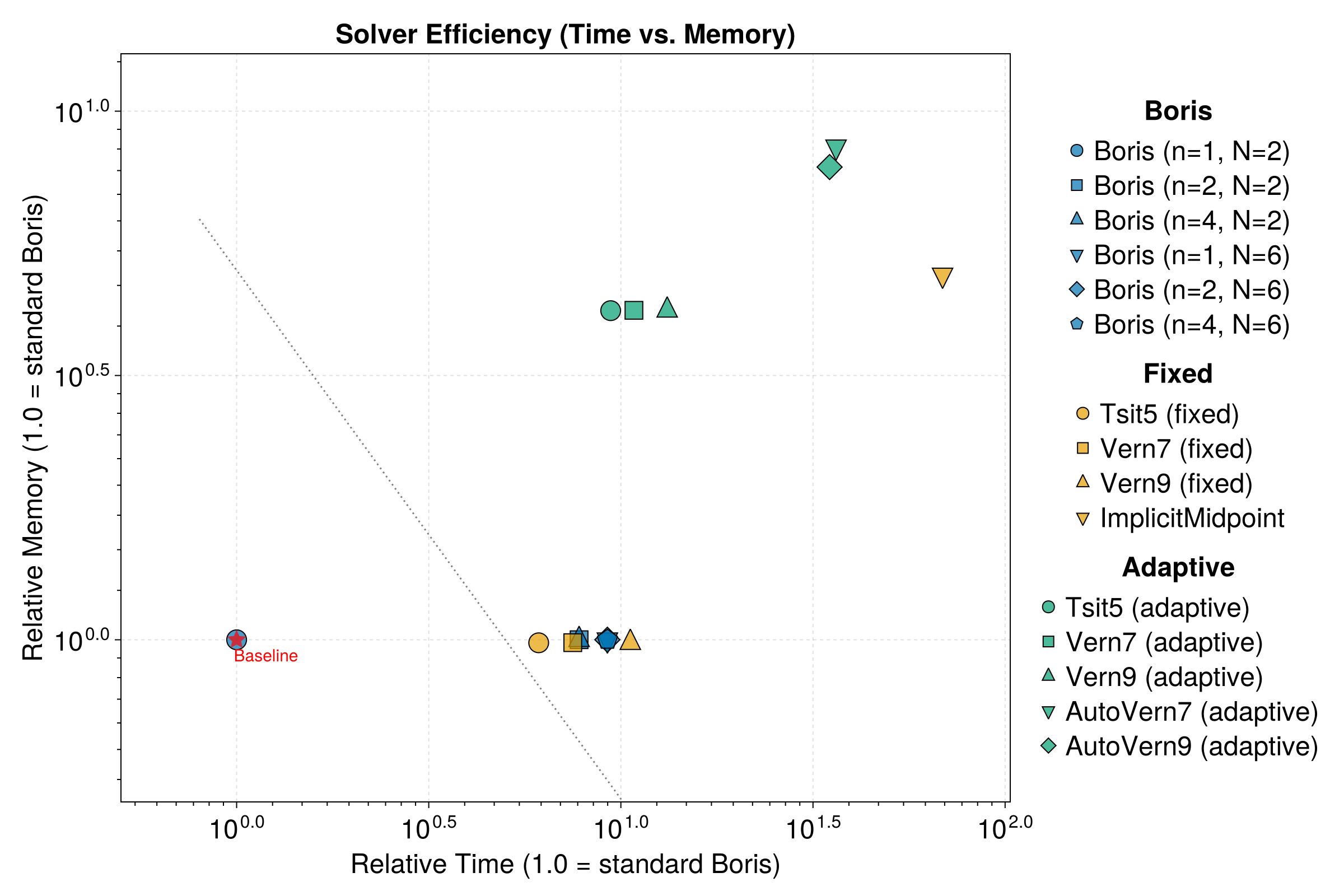
In practice, it is pretty hard to find an optimal algorithm. The native Boris method is good if you want a fixed time step. Within the native Boris family, MultistepBoris6(n=4) is the recommended default: sixth-order gyrophase accuracy at about 2.8x the cost of Boris(), without the numerical heating of the adaptive SciML solvers. When calling OrdinaryDiffEq.jl, we recommend using Vern9() as a starting point instead of Tsit5(), especially combined with adaptive timestepping. Further fine-grained control includes setting dtmax, reltol, and abstol in the solve method. Note: Geometric integrators from GeometricIntegratorsDiffEq were previously included but removed due to poor performance and compatibility issues compared to the optimized SciML solvers.