
Radiation
For an electron undergoing gyromotion in a constant magnetic field, the energy loss is caused by the emission of electromagnetic radiation. The rate of this energy loss (radiated power
- General Formula (Relativistic)
For an electron with charge
Alternatively, using
where:
$$\gamma = \frac{1}{\sqrt{1 - \beta^2}}$$
is the Lorentz factor.
is the vacuum permittivity.
is the speed of light.
is the pitch angle between the velocity vector and the magnetic field vector.
Note on Emission Pattern: In the relativistic regime (
), the radiation is beamed forward in a narrow cone along the direction of the electron's instantaneous velocity (the "searchlight effect"), which is characteristic of Synchrotron radiation.
- Non-Relativistic Limit (Cyclotron Radiation)
When the electron speed is much less than the speed of light (
Using the Thomson cross-section
- Energy Loss Per Turn
In accelerator physics, it is often useful to know the energy lost per complete revolution. For a highly relativistic electron (
This
- Cooling Time
The electron will lose energy over time, causing its orbit to decay. The characteristic cooling time
In the non-relativistic limit, this simplifies to
All the above equations are shown in CGS units.
using TestParticle: qᵢ as e, mₑ, c, ϵ₀
using CairoMakie
Physics Functions
"""
    calc_gamma(β)

Calculate the Lorentz factor γ given β (v/c).
"""
function calc_gamma(β)
    if β >= 1.0
        return Inf
    end
    return 1.0 / sqrt(1.0 - β^2)
end

"""
    radiated_power(B, β, α)

Calculate the instantaneous power radiated by an electron in a magnetic field.
Based on the relativistic generalization of the Larmor formula.

Parameters:
B: Magnetic field strength [Tesla]
β: Normalized velocity (v/c)
α: Pitch angle [radians] (angle between v and B)

Returns:
P     : Radiated Power [Watts]
"""
function radiated_power(B, β, α)
    gamma = calc_gamma(β)

    # Formula: P = (e^4 * B^2 * γ^2 * v_perp^2) / (6 * π * ϵ₀ * m^2 * c^3)
    # Substitute v_perp = v * sin(α) = β * c * sin(α)
    # Result: P = (e^4 * B^2 * γ^2 * β^2 * sin(α)^2) / (6 * π * ϵ₀ * m^2 * c)

    numerator = e^4 * B^2 * gamma^2 * β^2 * sin(α)^2
    denominator = 6 * π * ϵ₀ * (mₑ^2) * c

    return numerator / denominator
end
radiated_power (generic function with 1 method)Visualization
function main()
    fig = Figure(size = (1200, 900), fontsize = 18)

    # --- Plot: Power vs Magnetic Field B ---
    # Fixed parameters
    beta_fixed_1 = 0.9
    alpha_fixed_1 = π / 2 # Perpendicular

    B_range = range(0.1, 10.0, length = 200) # 0.1 T to 10 T
    P_B = radiated_power.(B_range, beta_fixed_1, alpha_fixed_1)

    ax1 = Axis(
        fig[1, 1],
        title = L"Power vs. Magnetic Field ($B$)",
        xlabel = "Magnetic Field B [T]",
        ylabel = "Power [W]",
        xscale = log10,
        yscale = log10
    )
    lines!(
        ax1, B_range, P_B, color = :blue, linewidth = 3,
        label = L"\beta = 0.9, \alpha = 90^\circ"
    )
    axislegend(ax1, position = :lt)
    text!(ax1, B_range[10], P_B[10], text = L"P \propto B^2", align = (:left, :bottom))

    # --- Plot: Power vs Velocity (β) ---
    # Fixed parameters
    B_fixed_2 = 1.0 # 1 Tesla
    alpha_fixed_2 = π / 2

    # Range close to 1 to show relativistic effects
    beta_range = range(0.1, 0.999, length = 500)
    P_beta = radiated_power.(B_fixed_2, beta_range, alpha_fixed_2)

    ax2 = Axis(
        fig[1, 2],
        title = L"Power vs. Velocity ($\beta$)",
        xlabel = L"Velocity $\beta = v/c$",
        ylabel = "Power [W]",
        yscale = log10
    )
    lines!(
        ax2, beta_range, P_beta, color = :red, linewidth = 3,
        label = L"B = 1\text{ T}, \alpha = 90^\circ"
    )
    axislegend(ax2, position = :lt)

    # --- Plot: Power vs Pitch Angle (α) ---
    # Fixed parameters
    B_fixed_3 = 1.0
    beta_fixed_3 = 0.9

    alpha_range = range(0, π, length = 360)
    alpha_deg = rad2deg.(alpha_range)
    P_alpha = radiated_power.(B_fixed_3, beta_fixed_3, alpha_range)

    ax3 = Axis(
        fig[2, 1],
        title = L"Power vs. Pitch Angle ($\alpha$)",
        xlabel = "Pitch Angle [Degrees]",
        ylabel = "Power [W]",
        xticks = 0:30:180
    )
    lines!(
        ax3, alpha_deg, P_alpha, color = :green,
        linewidth = 3, label = L"B=1\text{ T}, \beta=0.9"
    )
    # Add a visual marker for max power
    vlines!(ax3, [90], color = :black, linestyle = :dash)
    axislegend(ax3)

    # --- Plot: Heatmap (Log Power) vs B and β ---
    # Here we vary both B and β
    B_hm = range(0.1, 5.0, length = 100)
    beta_hm = range(0.5, 0.999, length = 100)

    # Calculate matrix
    P_matrix = log10.(radiated_power.(B_hm, beta_hm', π / 2))

    ax4 = Axis(
        fig[2, 2],
        title = "Log10(Power) Heatmap",
        xlabel = "Magnetic Field B [T]",
        ylabel = L"Velocity $\beta$"
    )
    hm = heatmap!(ax4, B_hm, beta_hm, P_matrix, colormap = :inferno)
    Colorbar(fig[2, 3], hm, label = "Log10(Power [W])")

    Label(
        fig[0, :], "Electron Cyclotron/Synchrotron Radiation Loss",
        fontsize = 24, font = :bold
    )

    return fig
end
main (generic function with 1 method)Run the visualization
f = main()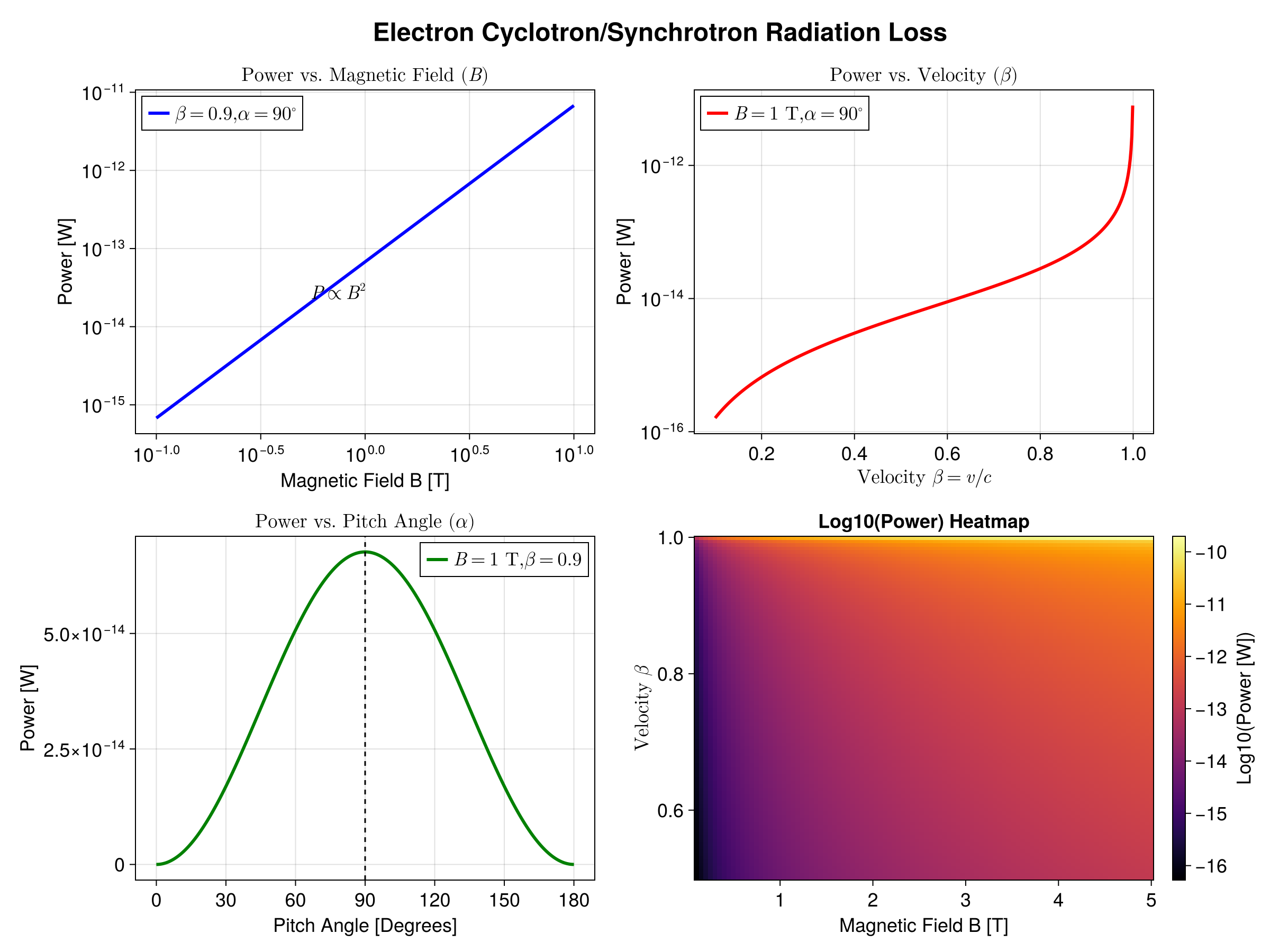
We need to consider radiation effects when the timescale of energy loss (the "cooling time") becomes comparable to or shorter than the characteristic timescale of our system (e.g., confinement time, acceleration time, or simulation duration).
- Weak Fields / Low Energy: If
and the electron is non-relativistic
(
- Strong Fields / High Energy: If
and you have a 1 GeV electron
(