
Magnetic Dipole
This example shows how to trace protons of a certain energy in a analytic Earth-like magnetic dipole field. There is a combination of grad-B drift, curvature drift, and the bounce motion between mirror points. It demonstrates the motions corresponding to the three adiabatic invariants.
using TestParticle, OrdinaryDiffEq, OrdinaryDiffEqSDIRK
import TestParticle as TP
using TestParticle: mᵢ, qᵢ, c, Rₑ
import Magnetostatics as MS
using CairoMakie

# Initial condition
stateinit = let
    # Initial particle energy
    Ek = 5.0e7 # [eV]
    # initial velocity, [m/s]
    v₀ = TP.sph2cart(c * sqrt(1 - 1 / (1 + Ek * qᵢ / (mᵢ * c^2))^2), π / 4, 0.0)
    # initial position, [m]
    r₀ = TP.sph2cart(2.5 * Rₑ, π / 2, 0.0)
    [r₀..., v₀...]
end
# Obtain field
Bfield = MS.Dipole(TP.BMoment_Earth)
B_func(r) = Bfield(r)
param = prepare(ZeroField(), B_func)
tspan = (0.0, 10.0);
Full Trajectory Tracing
We first show the tracing of full proton trajectory.
prob = ODEProblem(trace!, stateinit, tspan, param)
sol = solve(prob, Vern7(); dt = 1.0e-6);
Guiding Center Tracing
Next, we can trace the guiding center (GC) of the particle via trace_gc!. For more information about GC tracing, check out Demo: Guiding Center Approximation.
param = prepare(B_func)
stateinit_gc, param_gc = prepare_gc(stateinit, ZeroField(), B_func)
prob_gc = ODEProblem(trace_gc!, stateinit_gc, tspan, param_gc)
sol_gc = solve(prob_gc, Tsit5());
Visualization
We show the full proton trajectory and the GC trajectory together with the background dipole field. The GC trajectory is colored by the ratio between the magnetic field curvature and the gyroradius at each location.
f = Figure(fontsize = 18)
ax = Axis3(
    f[1, 1],
    title = "50 MeV Proton trajectory in Earth's dipole field",
    xlabel = "x [Re]",
    ylabel = "y [Re]",
    zlabel = "z [Re]",
    aspect = :data,
    azimuth = 1.42π,
    limits = (-2.5, 2.5, -2.5, 2.5, -1, 1)
)

nsample = 4000
tsample = range(tspan[1], tspan[2], length = nsample)
x = zeros(Float32, nsample)
y = zeros(Float32, nsample)
z = zeros(Float32, nsample)
for i in 1:nsample
    x[i], y[i], z[i] = sol(tsample[i])[1:3] ./ Rₑ
end

lines!(ax, x, y, z, label = "Full Orbit")

for ϕ in range(0, stop = 2 * π, length = 10)
    lines!(ax, MS.dipole_fieldline(ϕ)..., color = :tomato, alpha = 0.3)
end

# Plot GC trajectory
nsample = 1000
tsample = range(tspan[1], tspan[2], length = nsample)
xgc = zeros(Float32, nsample)
ygc = zeros(Float32, nsample)
zgc = zeros(Float32, nsample)
for i in 1:nsample
    xgc[i], ygc[i], zgc[i] = sol_gc(tsample[i])[1:3] ./ Rₑ
end
Calculate adiabaticity: ρ/Rc The 1st adiabaticity stands for the ratio between the curvature radius and the gyroradius. Here we show the inverse of adiabaticity for plotting.
ratio = let
    adiabaticity = [get_adiabaticity(sol_gc, t) for t in tsample]
    1 ./ adiabaticity
end

l_gc = lines!(
    ax, xgc, ygc, zgc, color = ratio, colormap = :plasma,
    linewidth = 3, label = "Guiding Center"
)
Colorbar(f[1, 2], l_gc, label = "Curvature Radius / Gyroradius")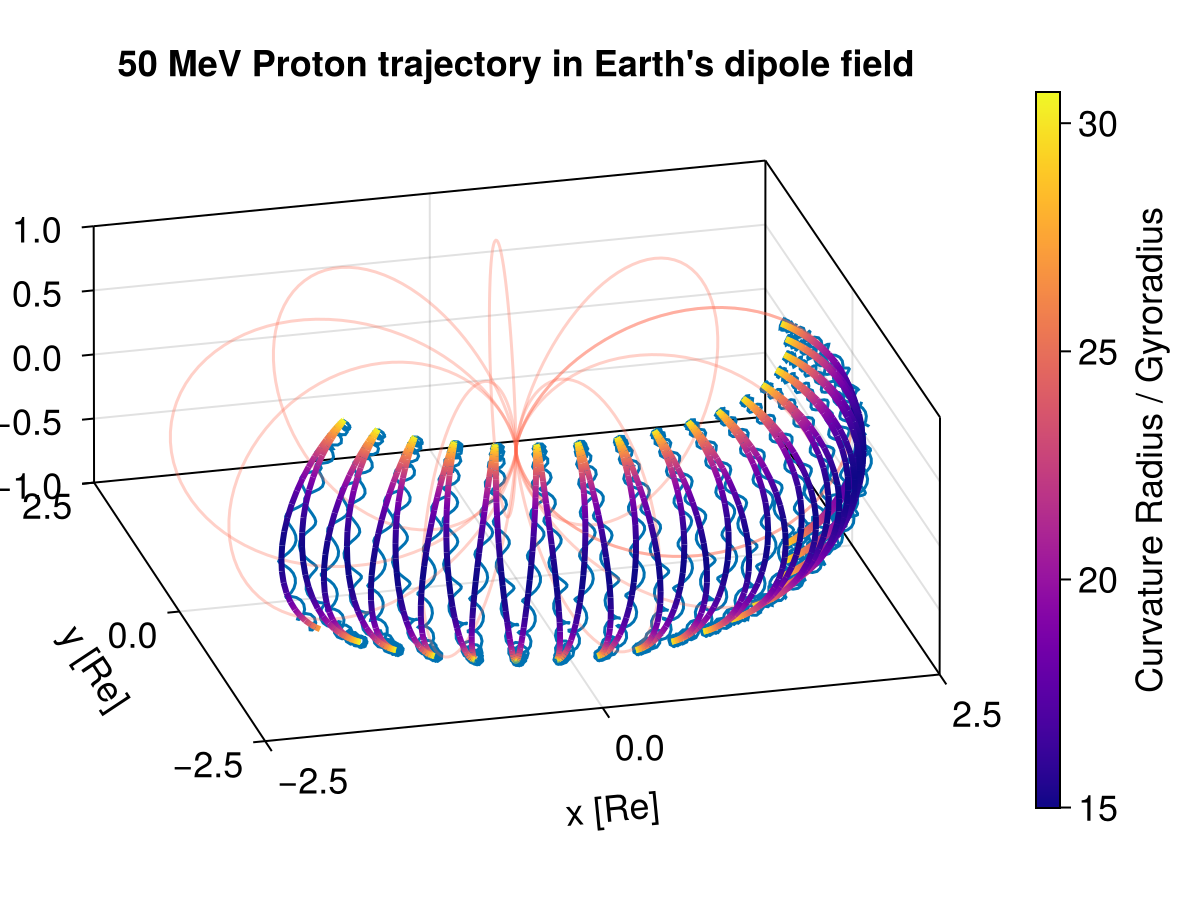
Solver algorithm matters in terms of energy conservation. In the above we used Verner's “Most Efficient” 7/6 Runge-Kutta method. Let's check other algorithms. Default stepsize settings may not be enough for our problem. By using a smaller abstol and reltol, we can guarantee much better conservation at a higher cost.
function get_energy_ratio(sol)
    vx = sol[4, :]
    vy = sol[5, :]
    vz = sol[6, :]

    Einit = vx[1]^2 + vy[1]^2 + vz[1]^2
    Eend = vx[end]^2 + vy[end]^2 + vz[end]^2

    return (Eend - Einit) / Einit
end

results = Tuple{String, Float64}[]

# OrdinaryDiffEq solvers
ode_solvers = [
    ("ImplicitMidpoint, dt=1e-3", ImplicitMidpoint(), Dict(:dt => 1.0e-3)),
    ("ImplicitMidpoint, dt=1e-4", ImplicitMidpoint(), Dict(:dt => 1.0e-4)),
    ("Vern9", Vern9(), Dict(:dt => 1.0e-4)),
    ("Trapezoid", Trapezoid(), Dict(:dt => 1.0e-4)),
    ("Vern6", Vern6(), Dict(:dt => 1.0e-4)),
    ("Tsit5", Tsit5(), Dict(:dt => 1.0e-4)),
    ("Tsit5, reltol=1e-4", Tsit5(), Dict(:dt => 1.0e-4, :reltol => 1.0e-4)),
]

for (name, alg, kwargs) in ode_solvers
    local sol = solve(prob, alg; kwargs...)
    push!(results, (name, get_energy_ratio(sol)))
end
Or, for adaptive time step algorithms like Vern9(), with the help of callbacks, we can enforce a largest time step smaller than 1/10 of the local gyroperiod:
using DiffEqCallbacks

# p = (charge_mass_ratio, m, E, B)
dtFE(u, p, t) = 2π / (abs(p[1]) * sqrt(sum(x -> x^2, p[4](u, t))))

cb = StepsizeLimiter(dtFE; safety_factor = 1 // 10, max_step = true)

sol = solve(prob, Vern9(); callback = cb, dt = 0.1) # dt=0.1 is a dummy value
push!(results, ("Vern9 with StepsizeLimiter", get_energy_ratio(sol)));
This is much more accurate, at the cost of more iterations. In terms of accuracy, this is roughly equivalent to solve(prob, Vern9(); reltol=1e-7); in terms of performance, it is 2x slower (0.04s v.s. 0.02s) and consumes about the same amount of memory 42 MiB. We can also use the classical Boris method implemented within the package:
dt = 1.0e-4
prob_boris = TraceProblem(stateinit, tspan, param)
sol_boris = solve(prob_boris, Boris(); dt)
push!(results, ("Boris method, dt=1e-4", get_energy_ratio(sol_boris)));
Comparison of energy conservation:
| Solver | Energy Ratio |
|---|---|
| ImplicitMidpoint, dt=1e-3 | -4.6101e-04 |
| ImplicitMidpoint, dt=1e-4 | -4.9528e-09 |
| Vern9 | -7.1319e-03 |
| Trapezoid | -4.8391e-02 |
| Vern6 | -6.5711e-02 |
| Tsit5 | 5.3928e-01 |
| Tsit5, reltol=1e-4 | 6.3081e-03 |
| Vern9 with StepsizeLimiter | -5.4019e-07 |
| Boris method, dt=1e-4 | -5.0766e-15 |
The Boris method requires a fixed time step. It takes about 0.05s and consumes 53 MiB memory. In this specific case, the time step is determined empirically. If we increase the time step to 1e-2 seconds, the trajectory becomes completely off (but the energy is still conserved). Therefore, as a rule of thumb, we should not use the default Tsit5() scheme without decreasing reltol. Use adaptive Vern9() for an unfamiliar field configuration, then switch to more accurate schemes if needed. A more thorough test can be found here.