
Shock Drift Acceleration at a Perpendicular Shock
This example shows Shock Drift Acceleration (SDA): a particle gains energy by drifting along the shock front in the convective electric field, while the cross-shock potential reflects it so it repeatedly hits the shock.
The setup is the perpendicular shock (
| Quantity | Direction |
|---|---|
| Shock normal | |
| Upstream flow | |
| Magnetic field | |
| Convection field |
The field only varies across the shock, so the only drift along the front is the gradient-
Cross-shock potential
A perpendicular shock also carries an electrostatic potential
We trace a real proton (
using TestParticle
using TestParticle: mᵢ, qᵢ
using OrdinaryDiffEq
using LinearAlgebra
using StaticArrays: SVector
using CairoMakie
Shock Parameters (perpendicular)
Upstream (Region 1) flows toward the shock along
V₁ = [545.0, 0.0, 0.0] .* 1.0e3   # upstream flow (into the shock, +x)
r = 4.0                            # field compression ratio
B₁ = [0.0, 0.0, 5.0] .* 1.0e-9      # upstream |B| [T], along z
B₂ = [0.0, 0.0, r * 5.0] .* 1.0e-9  # downstream, same direction
V₂ = V₁ ./ r                        # downstream flow (mass-flux conservation)
E_y = -(V₁ × B₁)[2]                 # motional E along +y, continuous across shock
E_y = 0.002725 (points along +y, as expected)Cross-shock potential (downstream at higher potential) and its normal field: φ(x) = Δφ · ½(1 + tanh(x/L)) E_x = -dφ/dx = -Δφ/(2L)·sech²(x/L) (points upstream)
Δφ = 15.0e3                          # cross-shock potential drop [V] (enhanced for visibility)
L = 1500.0e3                        # shock ramp half-width
Ex(xq) = -Δφ / (2L) / cosh(xq / L)^2;
Grid and finite-thickness shock
The fields live on a 1D grid in
x_max = 12_000.0e3
x = range(-x_max, x_max; length = 4000)
Bvecs = [B₁ .+ (B₂ .- B₁) .* 0.5 .* (1 .+ tanh(xq / L)) for xq in x]
Bm = hcat(Bvecs...)
Em = hcat([[Ex(xq), E_y, 0.0] for xq in x]...)

param = prepare(x, Em, Bm; bc = ClampExtrap(), q = qᵢ, m = mᵢ)

function field_at(xq, Em, Bm)
    i = clamp(searchsortedlast(x, xq) + 1, 1, length(x))
    return view(Em, :, i), view(Bm, :, i)
end

function drift_velocity(xq, Em, Bm)
    Evec, Bvec = field_at(xq, Em, Bm)
    b² = dot(Bvec, Bvec)
    return @inbounds SVector(
        (Evec[2] * Bvec[3] - Evec[3] * Bvec[2]) / b²,
        (Evec[3] * Bvec[1] - Evec[1] * Bvec[3]) / b²,
        (Evec[1] * Bvec[2] - Evec[2] * Bvec[1]) / b²,
    )
end;
Proton Injection
The proton starts upstream and gyrates in the
const x₀ = -6000.0e3
const v₀ = [0.0, -545.0e3, 0.0]
const t_max = 45.0

u0 = [x₀, 0.0, 0.0, v₀...]
prob = ODEProblem(trace!, u0, (0.0, t_max), param)
sol = solve(prob, Vern9(); saveat = 0.05);
Comparison case: injected with the ExB-drift velocity E×B/B² as the only initial speed, and launched deep upstream (x₀ = -4L) where the cross-shock potential's normal field E_x ≈ 0, so the ExB drift is essentially along +x. NOTE this is still NOT a gyration-free guiding center: the ExB speed |E|/B is itself perpendicular to B, so the proton keeps a perpendicular speed v_⊥ = |E|/B, a finite gyroradius, and a magnetic moment μ. It therefore gyrates in x-y — the y wiggle you still see upstream is that gyration (with ~zero net guiding-center y drift) — and once it enters the ramp where E_x ≠ 0 it gains a real +y drift and some gradient-B acceleration. (If the injection sat inside the ramp, as x₀ = -2500 km did, E_x(x₀) was ~24% of E_y and the ExB drift already carried +133 km/s in y, which is the upstream y drift you saw.) A truly gyration-free particle would need v ∥ B, which the exact v×B integrator could not carry into the shock at all.
v_ExB = drift_velocity(x₀, Em, Bm)          # E×B/B² at injection (includes the ramp's E_x)
u0_exb = [x₀, 0.0, 0.0, v_ExB...]
sol_exb = solve(ODEProblem(trace!, u0_exb, (0.0, t_max), param), Vern9(); saveat = 0.05)

X_exb = [u[1] for u in sol_exb.u]
Y_exb = [u[2] for u in sol_exb.u]
vs_exb = [u[4:6] for u in sol_exb.u]
K_exb = [0.5 * mᵢ * dot(v, v) for v in vs_exb]
work_exb = [qᵢ * dot(v, field_at(u[1], Em, Bm)[1]) for (u, v) in zip(sol_exb.u, vs_exb)]
W_exb = [0.0; cumsum(0.5 .* (work_exb[1:(end - 1)] .+ work_exb[2:end]) .* diff(sol_exb.t))]
W_exb_norm = W_exb ./ K_exb[1]              # normalized to its own initial KE
Pure-ExB case: cumulative work ends at -0.976x its own initial KEEnergy: the SDA signature
The particle's kinetic energy
ts = sol.t
X = [u[1] for u in sol.u]
Y = [u[2] for u in sol.u]
Z = [u[3] for u in sol.u]
vs = [u[4:6] for u in sol.u]

K_lab = [0.5 * mᵢ * dot(v, v) for v in vs]
work_rates = [qᵢ * dot(v, field_at(u[1], Em, Bm)[1]) for (u, v) in zip(sol.u, vs)]
W_cum = [0.0; cumsum(0.5 .* (work_rates[1:(end - 1)] .+ work_rates[2:end]) .* diff(ts))]

n_cross = count(i -> (X[i - 1] < 0 <= X[i] || X[i - 1] > 0 >= X[i]), 2:length(X))

K_norm = K_lab ./ K_lab[1]
W_norm = W_cum ./ K_lab[1];
Perpendicular velocity and gyro-phase. B points along z, so the gyration lies in the x-y plane; the velocity-phase atan2(v_y, v_x) measures where the perpendicular velocity points and sets the sign of q v_y E_y (the energy work term). Phase 0 is defined by convention as the perpendicular velocity pointing along +x (atan2(v_y, v_x) = 0 when v_y = 0, v_x > 0); we wrap it into the [0, 360)° interval so it spans exactly one gyration.
vys_kms = [v[2] for v in vs] ./ 1.0e3
gyro_phase = [mod(atan(v[2], v[1]) * 180 / π, 360) for v in vs]
Shock encounters (crossings of x=0): 3
Perpendicular-shock SDA: proton KE ends at 8.54x; cumulative work from E ends at 7.54x initialVisualization
f = Figure(size = (1400, 1400), fontsize = 28)
wc = Makie.wong_colors()    # default discrete (Wong) palette

xpad = 500.0e3; ypad = 2000.0e3
xlim = (minimum(X) - xpad, maximum(X) + xpad)
ylim = (minimum(Y) - ypad, maximum(Y) + ypad)

# Top row: 2D X-Y trajectory (colored by gained energy)
ax2d = Axis(
    f[1, 1];
    title = "Proton trajectory (colored by gained energy)",
    xlabel = L"x\;[\mathrm{km}]", ylabel = L"y\;[\mathrm{km}]",
    aspect = DataAspect(),
    limits = (xlim ./ 1.0e3, ylim ./ 1.0e3),
)

# Cross-shock potential ramp region (where φ(x) is set); shaded band behind the trajectories
xlo_pot, xhi_pot = -L / 1.0e3, L / 1.0e3   # nominal ramp half-width, in km
band!(
    ax2d, [xlo_pot, xhi_pot],
    fill(ylim[1] / 1.0e3, 2), fill(ylim[2] / 1.0e3, 2);
    color = (:gray, 0.18),
)
text!(
    ax2d, 0.0, ylim[2] / 1.0e3;
    text = "cross-shock potential φ(x)", align = (:center, :top), fontsize = 20,
)

# Upstream / downstream region labels (rotated 90° to save horizontal space)
y_mid = (ylim[1] + ylim[2]) / 2.0e3
text!(
    ax2d, xlim[1] / 1.0e3 + 300.0, y_mid;
    text = "upstream (x < 0)", rotation = π / 2, align = (:center, :center),
    fontsize = 22, color = (:gray, 0.8),
)
text!(
    ax2d, xlim[2] / 1.0e3 - 300.0, y_mid;
    text = "downstream (x > 0)", rotation = π / 2, align = (:center, :center),
    fontsize = 22, color = (:gray, 0.8),
)

l_sda = lines!(
    ax2d, X ./ 1.0e3, Y ./ 1.0e3;
    color = K_norm, colormap = :plasma, linewidth = 2.0,
    label = "SDA (with gyration)",
)
l_exb = lines!(
    ax2d, X_exb ./ 1.0e3, Y_exb ./ 1.0e3;
    color = :red, linestyle = :dash, linewidth = 1.5,
    label = "pure ExB drift",
)
cb = Colorbar(
    f[1, 3], limits = (1, maximum(K_norm)),
    colormap = :plasma, label = L"K / K_0"
)
cb.width = 18

# Shock front (vertical line at x = 0)
vlines!(ax2d, 0.0; color = (:red, 0.5), linewidth = 3)

# Legend placed just right of the trajectory axis (then the colorbar sits on the far right)
Legend(
    f[1, 2], [l_sda, l_exb], ["SDA (with gyration)", "pure ExB drift"];
    orientation = :vertical, framevisible = true, backgroundcolor = (:white, 0.7),
)

# Bottom row: energy time series
axE = Axis(
    f[2, 1:2];
    xlabel = "Time [s]", ylabel = L"K / K_0",
    limits = (nothing, (-2, 12)),
)
lines!(axE, ts, K_norm; label = "instantaneous KE (lab frame)", color = :gray, linewidth = 1.5)
lines!(axE, ts, W_norm; label = "cumulative work q∫v·E dt (SDA)", color = :black, linewidth = 2.5)
lines!(axE, sol_exb.t, W_exb_norm; label = "pure ExB drift", color = :red, linestyle = :dash, linewidth = 2.0)
axislegend(axE; position = :lt, framevisible = true, backgroundcolor = (:white, 0.7))

# Third row: v_y and gyro-phase time series (x-axis linked with the energy panel)
axVy = Axis(
    f[3, 1:2];
    xlabel = "Time [s]",
    ylabel = L"v_y\;[\mathrm{km/s}]",
)
lines!(axVy, ts, vys_kms; label = L"v_y", color = wc[1], linewidth = 3.0)

axPhase = Axis(
    f[3, 1:2];
    yaxisposition = :right,
    ylabel = L"\phi\;[\!^{\circ}]",
    limits = (nothing, (0, 360)),
    yticks = [0, 90, 180, 270, 360],
)
hidexdecorations!(axPhase; grid = false)
lines!(axPhase, ts, gyro_phase; label = "gyro-phase", color = wc[2], linewidth = 3.0)

axislegend(axVy; position = :lt, framevisible = true, backgroundcolor = (:white, 0.7))
axislegend(axPhase; position = :rb, framevisible = true, backgroundcolor = (:white, 0.7))
linkxaxes!(axE, axVy, axPhase)

# Row heights: trajectory panel takes the largest share, time series panels are shorter
rowsize!(f.layout, 1, Relative(0.6))
rowsize!(f.layout, 2, Relative(0.2))
rowsize!(f.layout, 3, Relative(0.2))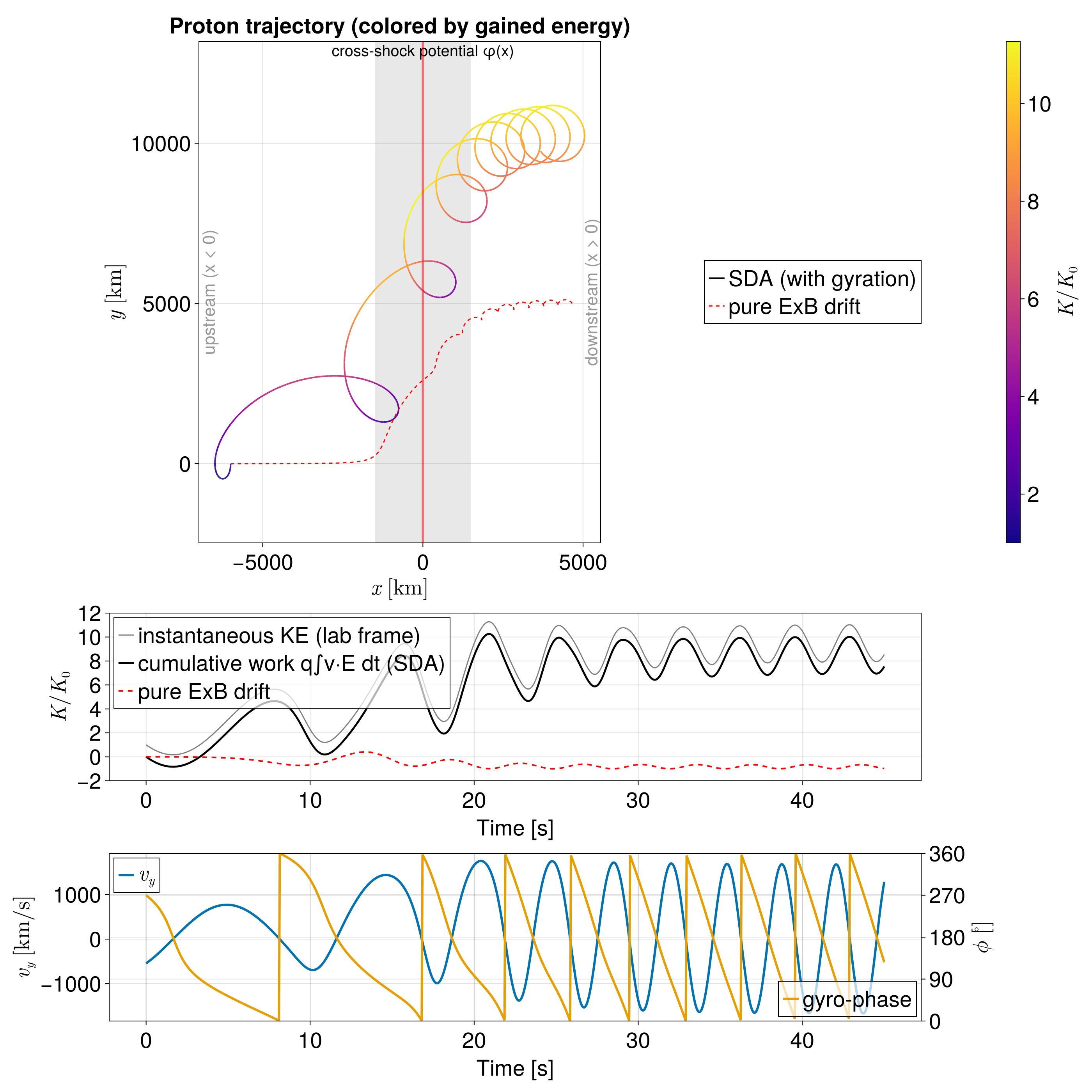
The proton is carried into the red shock front by the normal ExB drift, reflected by the cross-shock potential, and meets the front repeatedly. Each encounter adds energy from