Biot-Savart Solver
The magnetic field for a finite wire segment is calculated using the algebraic form of the Biot-Savart law:
where
For arbitrary wire geometries, discretize the path and sum the contributions.
using Magnetostatics, StaticArrays, LinearAlgebra
using CairoMakie

# Define a circular loop and discretize it
loop = CurrentLoop(1.0, 1.0, [0, 0, 0], [0, 0, 1])
wire = discretize_loop(loop, 100)

# Define the solver
solver = BiotSavart()

# Solve for B at a point
r = SVector(0.0, 0.0, 0.5)
B = solve(solver, wire, r)
println("B at $r: $B [T]")
B at [0.0, 0.0, 0.5]: [-1.4475660719677984e-23, 1.3609706015911533e-23, 4.4964729452166677e-7] [T]Visualizing the result:
xs = range(-2, 2, length=51)
zs = range(-2, 2, length=51)

function field_xz_bs(x, z)
    B = solve(solver, wire, SVector(x, 0.0, z))
    return Point2f(B[1], B[3])
end

fig = Figure(size = (700, 600), fontsize=20)
ax = Axis(fig[1, 1];
    xlabel="x", ylabel="z", aspect=DataAspect(), title="Biot-Savart Loop Field")

Bmag = [norm(solve(solver, wire, SVector(x, 0.0, z))) for x in xs, z in zs]
hm = heatmap!(ax, xs, zs, log10.(Bmag .+ 1e-9), colormap=:plasma)
Colorbar(fig[1, 2], hm, label="log10(|B|)")

streamplot!(ax, field_xz_bs, -2..2, -2..2;
    arrow_size = 8, linewidth = 1.5)

fig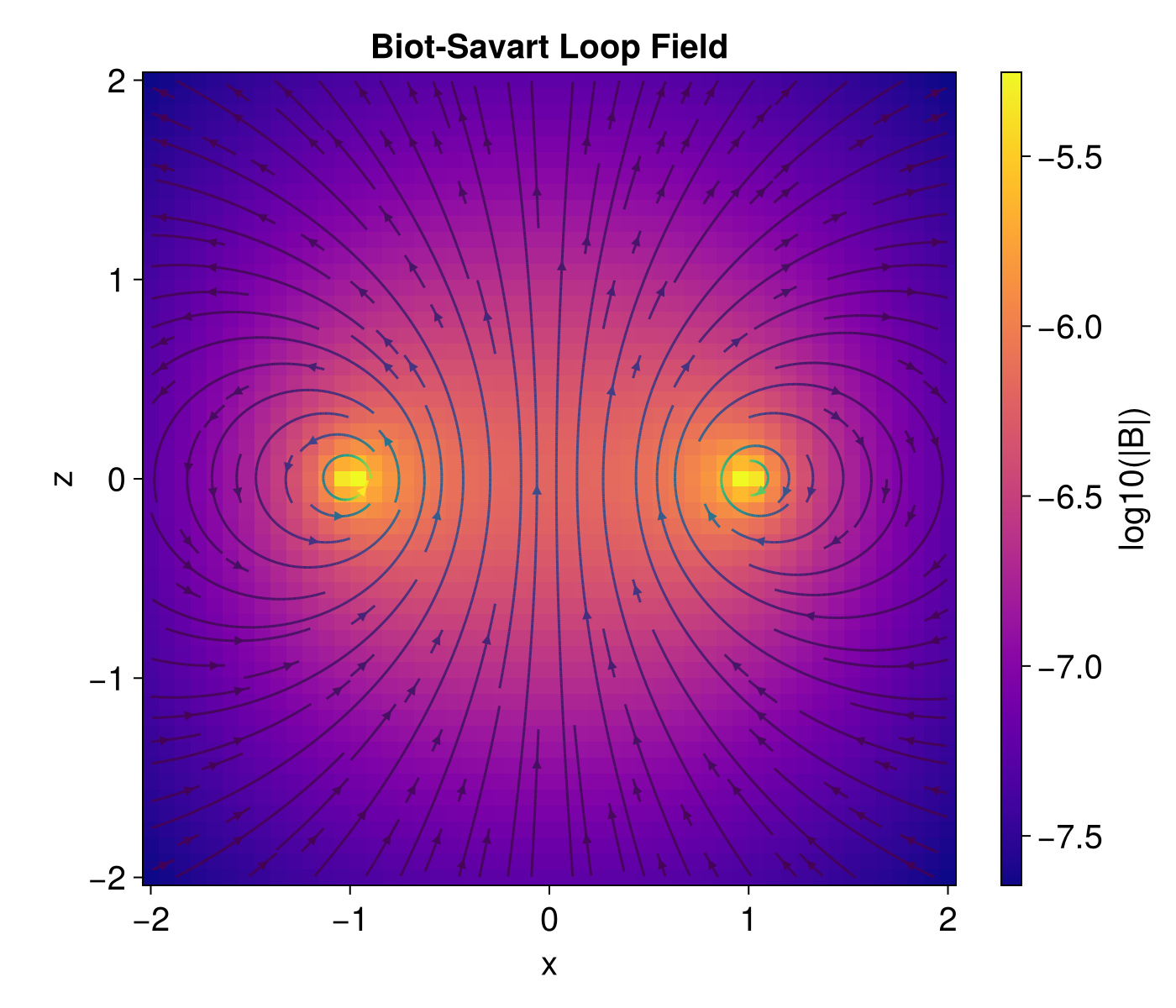
Conducting Wall (Method of Images)
A perfectly-conducting plane forces the normal component of
using Magnetostatics, StaticArrays, LinearAlgebra

# Wire along the y-axis at height h above the wall z = 0
h     = 1.0   # height above the wall [m]
I_w   = 1.0   # current [A]
L     = 10.0  # half-length of the wire approximating an infinite wire

wire_wall = Wire(
    [SVector(0.0, -L, h), SVector(0.0, L, h)],
    I_w
)

bc_wall   = ConductingWall(3, 0.0)   # wall normal along z-axis (axis=3), at z=0
solver_wall = BiotSavart(bc_wall)

B_wall(x, z) = solve(solver_wall, wire_wall, SVector(x, 0.0, z))

# Visualise field in the xz half-plane above the wall
xs_w = range(-4.0, 4.0, length=61)
zs_w = range(0.0,  4.0, length=31)

Bmag_w = [norm(B_wall(x, z)) for x in xs_w, z in zs_w]

fig_wall = Figure(size=(700, 500), fontsize=20)
ax_wall  = Axis(fig_wall[1, 1];
    xlabel="x [m]", ylabel="z [m]", aspect=DataAspect(),
    title="Wire above Conducting Wall (z = 0)")

hm_w = heatmap!(ax_wall, xs_w, zs_w, log10.(Bmag_w .+ 1e-9); colormap=:plasma)
Colorbar(fig_wall[1, 2], hm_w; label="log10(|B| / T)")

streamplot!(ax_wall,
    (x, z) -> let B = B_wall(Float64(x), Float64(z)); Point2f(B[1], B[3]) end,
    -4..4, 0..4; arrow_size=8, linewidth=1.5)

# Wall boundary
hlines!(ax_wall, [0.0]; color=:white, linewidth=2, linestyle=:dash)
scatter!(ax_wall, [0.0], [h]; color=:yellow, markersize=12, label="wire")
axislegend(ax_wall; position=:rt)

fig_wall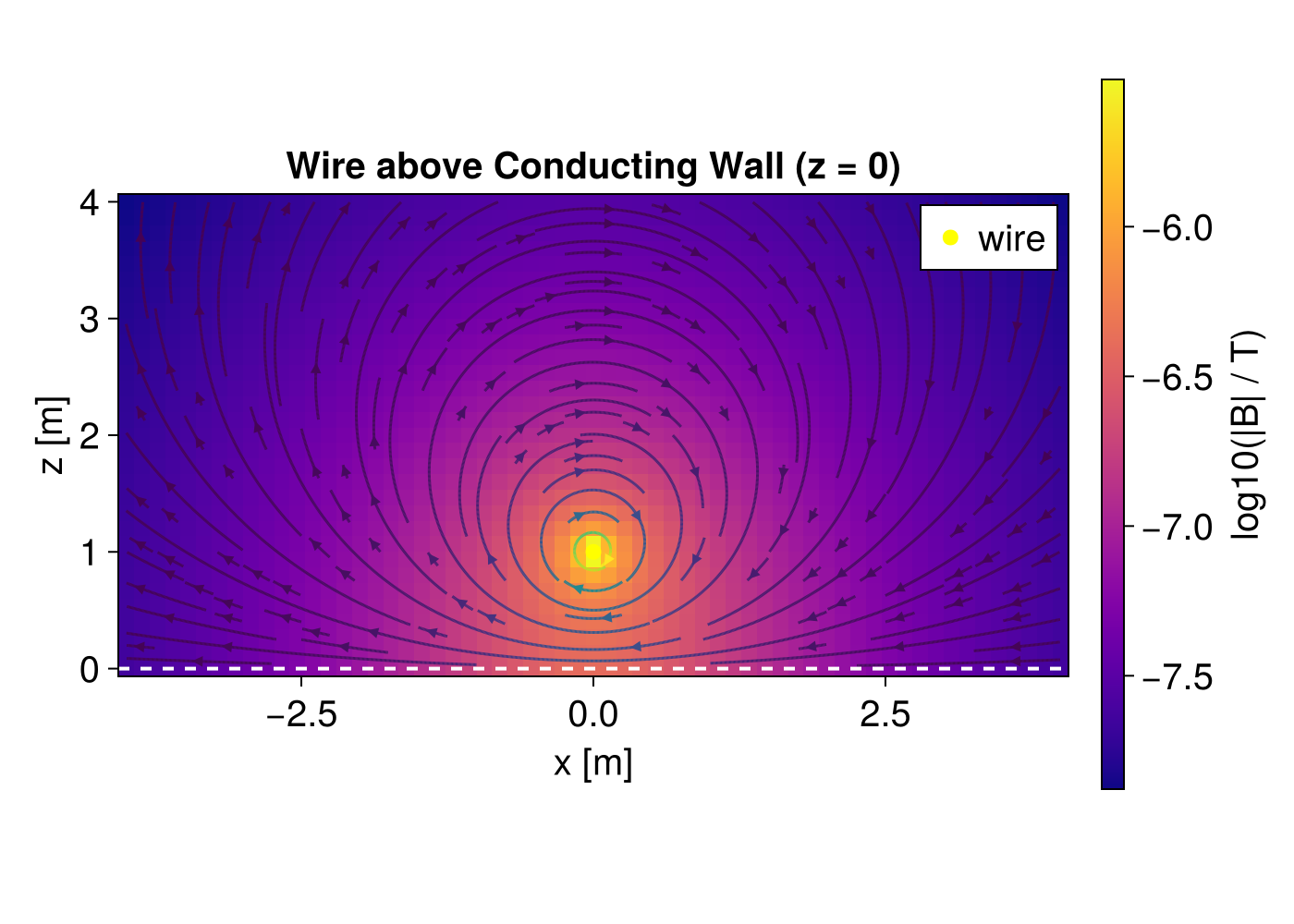
Analytical verification
At the wall surface (
and can be verified numerically:
xs_check = range(-4.0, 4.0, length=40)
Bz_at_wall = [B_wall(x, 1e-6)[3] for x in xs_check]   # just above z=0
println("max |Bz| at wall: ", maximum(abs, Bz_at_wall))
max |Bz| at wall: 2.571778923433936e-13Conducting Sphere in a Uniform Background Field
A perfectly-conducting sphere expels all magnetic flux from its interior. When placed in an external field
The negative sign on ConductingSphere BEM solver to find the induced surface currents numerically.
using Magnetostatics, StaticArrays, LinearAlgebra

# --- Problem parameters ---
B0 = 1.0   # background field magnitude [T]
R  = 1.0   # sphere radius [m]

# Approximate B0 ẑ with a Helmholtz pair (radius 10R, separation 10R)
# Each loop current chosen so that B_z at the origin equals B0.
# For a Helmholtz pair: B_z = μ0 I R² / (R²+(R/2)²)^(3/2) (two loops)
R_coil  = 10R
I_coil  = B0 * (R_coil^2 + (R_coil/2)^2)^(3/2) / (Magnetostatics.μ₀ * R_coil^2)
loop_p  = discretize_loop(R_coil, 200, I_coil;
              center=SVector(0.0, 0.0,  R_coil/2), normal=SVector(0.0, 0.0, 1.0))
loop_m  = discretize_loop(R_coil, 200, I_coil;
              center=SVector(0.0, 0.0, -R_coil/2), normal=SVector(0.0, 0.0, 1.0))

# Combine into a single Wire for the BEM (concatenate segments)
helmholtz = Wire(
    vcat(loop_p.points, loop_m.points),
    I_coil
)

# --- BEM solve for the conducting sphere ---
bc   = ConductingSphere(SVector(0.0, 0.0, 0.0), R, 32, 64)
mesh = compute_surface_current(bc, helmholtz)

bare = BiotSavart()
B_total(r) = solve(bare, helmholtz, r) + solve(bare, mesh, r)

# --- Visualisation: field lines in the xz-plane ---
xs = range(-3R, 3R, length=61)
zs = range(-3R, 3R, length=61)

# Mask points inside the sphere (field is zero there)
in_sphere(x, z) = sqrt(x^2 + z^2) < R

fig2 = Figure(size=(700, 650), fontsize=20)
ax2  = Axis(fig2[1, 1];
    xlabel="x / R", ylabel="z / R", aspect=DataAspect(),
    title="Conducting Sphere (R=1) in Uniform Bz")

Bmag = [in_sphere(x, z) ? NaN :
        norm(B_total(SVector(x, 0.0, z))) for x in xs, z in zs]
hm = heatmap!(ax2, xs ./ R, zs ./ R, log10.(Bmag .+ 1e-9); colormap=:plasma)
Colorbar(fig2[1, 2], hm; label="log10(|B| / T)")

streamplot!(ax2,
    (x, z) -> in_sphere(x, z) ?
        Point2f(0, 0) :
        let B = B_total(SVector(Float64(x*R), 0.0, Float64(z*R)))
            Point2f(B[1], B[3])
        end,
    -3..3, -3..3; arrow_size=8, linewidth=1.5)

# Draw sphere boundary
θs = range(0, 2π, length=200)
lines!(ax2, cos.(θs), sin.(θs); color=:white, linewidth=2, linestyle=:dash)

fig2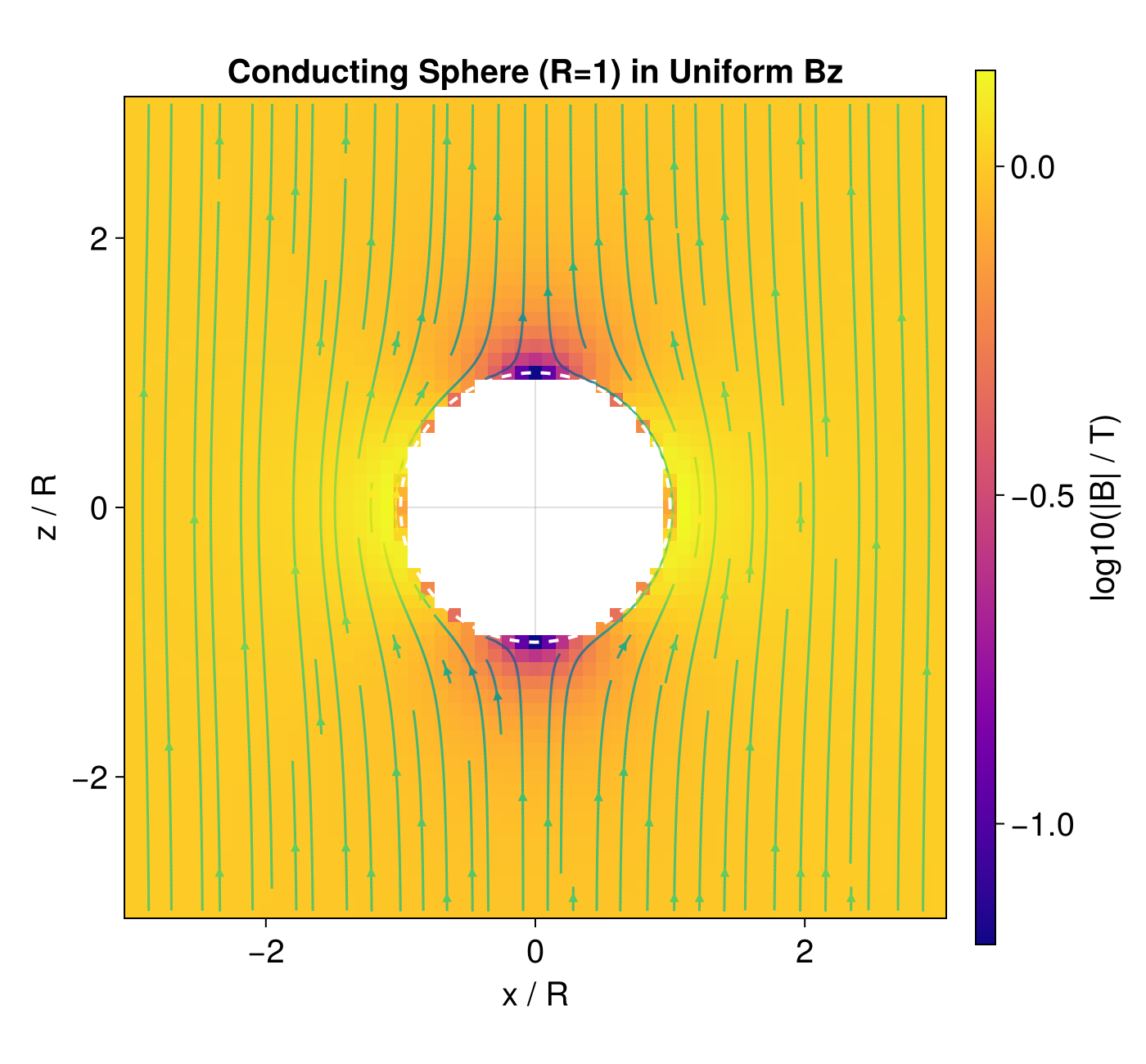
Analytical validation
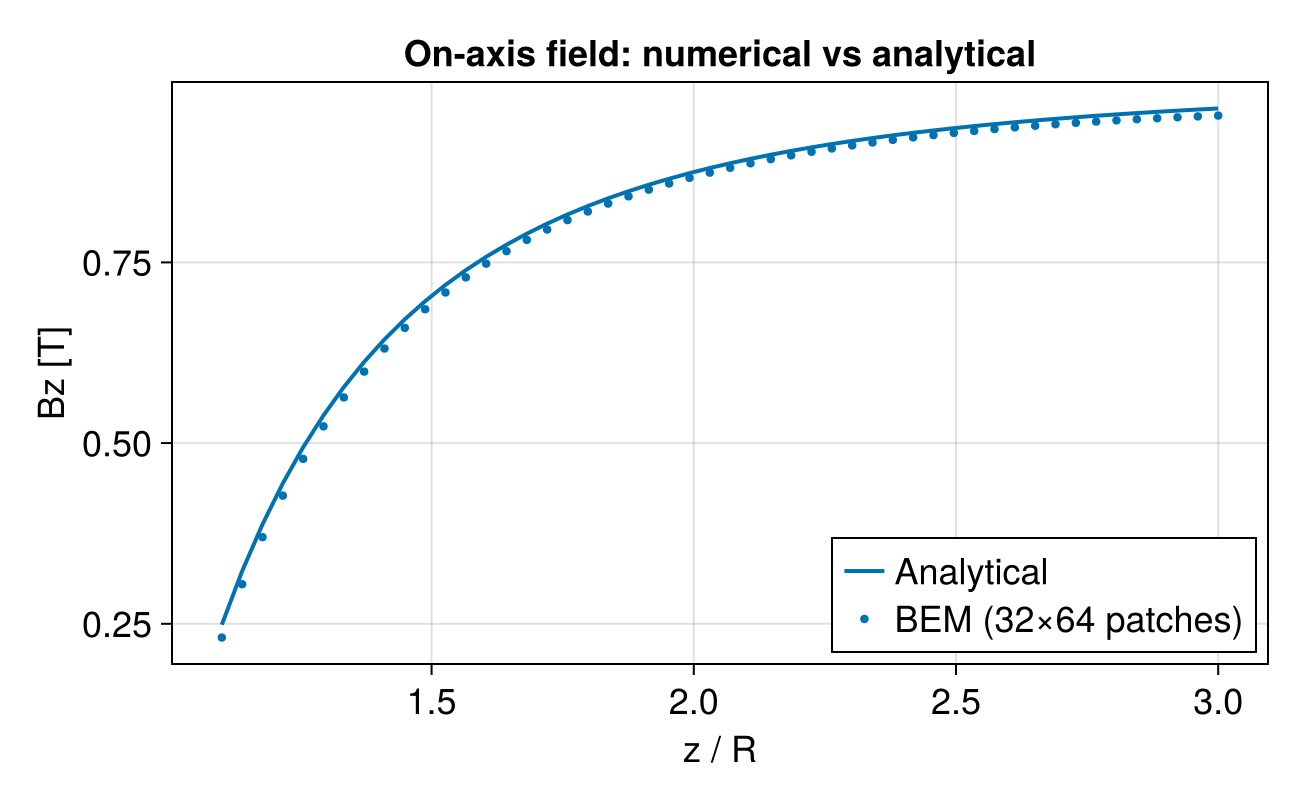
On the positive z-axis at
At
zs_axis = range(1.1R, 3R, length=50)
Bz_num  = [B_total(SVector(0.0, 0.0, z))[3] for z in zs_axis]
Bz_ana  = @. B0 * (1 - R^3 / zs_axis^3)

fig3 = Figure(size=(650, 400), fontsize=18)
ax3  = Axis(fig3[1, 1];
    xlabel="z / R", ylabel="Bz [T]",
    title="On-axis field: numerical vs analytical")
lines!(ax3, zs_axis ./ R, Bz_ana; label="Analytical", linewidth=2)
scatter!(ax3, zs_axis ./ R, Bz_num; label="BEM (32×64 patches)", markersize=6)
axislegend(ax3; position=:rb)
fig3